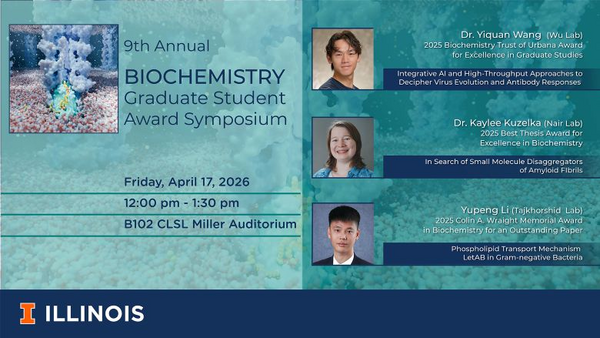
9th Annual Biochemistry Graduate Student Awards Symposium
- Sponsor
- Department of Biochemistry
- Contact
- Cale Fleming
- cdf@illinois.edu
- Phone
- 217-300-0545
- Views
- 72
- Originating Calendar
- Biochemistry Department Seminars
2025 Biochemistry Trust of Urbana Award for Excellence in Graduate Studies
Yiquan Wang (Wu Lab)
Integrative AI and High-Throughput Approaches to Decipher Virus Evolution and Antibody ResponsesAbstract: Predicting how viruses evolve and how the immune system responds is a fundamental challenge in infectious disease research. This talk will detail the development of high-throughput experimental and computational frameworks designed to map these complex biological landscapes. Focusing on influenza virus evolution, we utilized deep mutational scanning (DMS) and next-generation sequencing (NGS) to identify the biophysical constraints that dictate viral fitness, such as charge balancing in H3N2 neuraminidase. Building on these experimental foundations, we explored the "landscape" of antibody specificity, developing deep learning models to predict antibody recognition and streamline the discovery of potent therapeutics. The final portion of the talk will discuss how these data-rich experimental approaches are now being integrated into the "Mechanistic Understanding of Sequence Evolution" (MUSE) program. By developing AI agents for automated analysis and establishing closed-loop experiment-modeling systems, we aim to move toward interpretable foundation models that can anticipate viral trajectories and guide the design of next-generation vaccines.
Recommend paper: https://www.cell.com/immunity/fulltext/S1074-7613(24)00371-6
2025 Best Thesis Award for Excellence in Biochemistry
Kaylee Kuzelka (Nair Lab)
In search of small molecule disagregators of amyloid fibrils
2025 Colin A. Wraight Memorial Award in Biochemistry for an Outstanding Paper
Yupeng Li (Tajkhorshid Lab)
Phospholipid Transport Mechanism by LetAB in Gram-negative BacteriaAbstract: Gram-negative bacteria possess dual-membrane architecture, characterized by an inner membrane (IM) and an asymmetric outer membrane (OM), which together form a robust barrier against environmental stresses. A key unresolved question has been how phospholipids, synthesized in the cytoplasm, are transported from the IM, across the periplasm, to the OM. Although LetAB has emerged as one of the strong candidates for facilitating phospholipid transport, its mechanisms including lipid extraction from the IM by LetA and transfer to LetB, have remained unclear. Armed with the first high-resolution cryo-EM structure of the whole LetAB complex, we performed extensive molecular dynamics (MD) simulations resulting in deep mechanistic insights. Water penetration from both the cytoplasmic and periplasmic sides of LetA, coupled with key polar residues extending through the membrane, provides a plausible mechanism for protons as the motive force to drive phospholipid transport. Remarkably, a phospholipid ascended spontaneously and stably bound to the central cavity of LetA, which indicates the start of a previously unknown transport pathway. To further explore this, we applied steered MD (SMD) simulations to guide the elevated lipid stepwise through critical regions within LetA, identified as least tolerant to mutations based on fitness data. SMD simulations revealed that phospholipid transport likely requires conformational changes in LetA, as evidenced by the opening of an amphiphilic groove. Additionally, the steered lipid was observed to behave flexibly within the LetB-adjacent pocket of LetA and, in some replicas, it even flipped its orientation. Notably, we observed lipid diffusion towards the interior hydrophobic tunnel of LetB, signifying the entry point for lipid transfer from LetA to LetB. This study not only elucidates a potential phospholipid transport pathway within LetA but also provides compelling evidence for proton-coupled lipid transport, marking a significant advance in our understanding of phospholipid transport in Gram-negative bacteria.
Related paper: https://www.nature.com/articles/s41586-025-09990-0