NCSA staff who would like to submit an item for the calendar can email newsdesk@ncsa.illinois.edu.
- Sponsor
- IQUIST
- Speaker
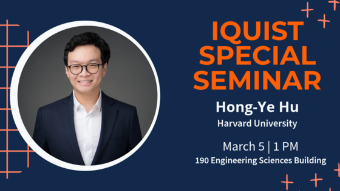
- Speaker: Hong-Ye Hu, Harvard Quantum Initiative (HQI) Fellow, Harvard University
- Contact
- Stephanie Gilmore
- stephg1@illinois.edu
- Phone
- 217-244-9570
- Views
- 224
- Originating Calendar
- IQUIST Seminar Series
"Scalable Quantum Applications: Synergies in Control, Learning, and Co-design"Abstract: The rapid advancement of quantum science and technology has ushered in a new era where analog simulators can now control thousands of qubits and digital processors are approaching break-even points for error correction. However, bridging the gap to large-scale quantum applications demands synergistic innovation across hardware-aware control, rigorous learning protocols, and algorithm-hardware co-design. In this talk, I will demonstrate the utility of this full-stack approach, focusing first on the untapped potential of analog platforms. I will show that globally controlled systems can exhibit universal quantum dynamics even without local addressability. By leveraging a novel direct optimal control technique, we experimentally realized effective three-body interactions in a globally driven Rydberg atom array, a critical resource for simulating exotic quantum phases. As system sizes scale, the ability to efficiently learn and benchmark devices also becomes critical. Traditional methods like quantum process tomography are exponentially expensive, while scalable alternatives, such as Hamiltonian learning, typically rely on structural ansätze that induce bias. To address this, we introduced the first Hamiltonian learning algorithm that functions without any structural ansatz while retaining optimal experimental scaling. This paradigm shift enables the rigorous, in-situ benchmarking of large-scale devices, allowing us to characterize unknown interactions and noise sources without preconceptions. Finally, I will conclude with perspectives on the future of scalable quantum systems, specifically focusing on AI-assisted quantum control and fault-tolerant architectural designs.
Bio: Hong-Ye Hu is a Harvard Quantum Initiative (HQI) Fellow working at the intersection of quantum information theory, quantum many-body physics, and machine learning. His research focuses on developing scalable methods for quantum control, verification, and learning in complex quantum systems, with applications to quantum simulation, early fault-tolerant quantum computing, and quantum error correction, as well as modern deep-learning approaches for quantum physics. Hong-Ye received his Ph.D. in Physics from the University of California, San Diego in 2022. He has been supported by the Harvard Quantum Initiative Fellowship, the NASA QuAIL Feynman Scholarship, the UCSD Chair’s Challenge Award, and a Unitary Fund grant. He collaborates extensively with both academic and industry partners, including IBM Quantum, QuEra Computing, NASA Quantum AI Lab, and Rigetti Computing.