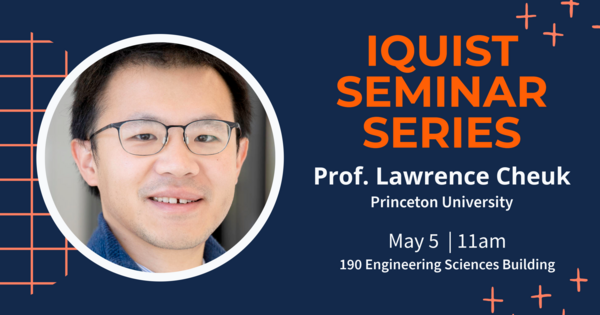
IQUIST Seminar: "Exploring Interacting Spin Physics with Molecular Tweezer Arrays," Lawrence Cheuk, Assistant Professor of Physics, Princeton University
- Sponsor
- IQUIST
- Speaker
- Lawrence Cheuk, Assistant Professor of Physics, Princeton University
- Contact
- Stephanie Gilmore
- stephg1@illinois.edu
- Phone
- 217-244-9570
- Views
- 40
- Originating Calendar
- IQUIST Seminar Series
Abstract: Optical tweezer arrays of polar molecules are a new quantum platform that combines the richness of molecules with the microscopic control of rearrangeable optical tweezer arrays. With molecules, long-lived internal states combined with long-ranged electric dipolar interactions open new possibilities in quantum simulation, quantum information processing, and quantum metrology.
In this talk, I will report recent work from our group exploring interacting spin physics with mesoscopic molecular tweezer arrays. First, I will report a set of quantum simulation experiments probing coherent spin dynamics in 1D 1/r^3 XXZ/XYZ spin chains. Through quench dynamics, we reveal a variety of phenomena including coherent quantum walks of single spin excitations, emergence of two-magnon bound states, and coherent creation and annihilation of spin pairs. Next, I will describe work where we explore many-body spin physics through the lens of quantum-enhanced metrology. Using XXZ spin models in 1D, we create metrologically useful many-body entangled states of molecules for the first time. Specifically, I will describe how we create spin-squeezed states and demonstrate their metrological advantage. I will discuss several aspects of these states that we have observed, including the structure of squeezing correlations and bipartite entanglement. Lastly, if time permits, I will briefly describe ongoing work on scaling up molecular tweezer arrays.Bio: Lawrence Cheuk is an assistant professor in the Department of Physics at Princeton University. He earned his bachelor's degree from Princeton University in 2010, and his Ph.D. from MIT in 2017. He subsequently moved to Harvard University as a Max Planck/Harvard Quantum Optics postdoctoral research fellow, before starting at Princeton in 2020. His current research focuses on using molecules for quantum science, specifically in the areas of quantum simulation, quantum information processing, and quantum-enhanced metrology. He has received several awards over the years including a Sloan Fellowship, an Air Force Office of Scientific Research Young Investigators Program Award, the OYRA Ardentec Prize.
To watch online, go to the IQUIST YouTube channel: https://www.youtube.com/channel/UCCzAySwQXF8J4kRolUzg2ww