- Sponsor
- Center for the Study of Global Gender Equity
- Speaker
- Emily L.B. Twarog, Professor, Labor and Employment Relations
- Cost
- Free and open to the public
- Registration
- Registration
- Contact
- Anita Kaiser
- csggeatillinois@illinois.edu
- Originating Calendar
- Center for the Study of Global Gender Equity
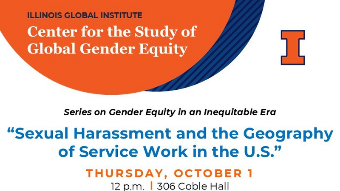
Lunch Talk title: Sexual Harassment and the Geography of Service Work in the US
“[At]…my first housekeeping job, I got discriminated because I was a heavyset woman…I thought I was doing good. At the end of the shift, they called me to the office. You're too big. You can't get on your knees and clean, so we don't need you.” Sheila Taylor, Room Attendant, Aria Hotel, Las Vegas, November 19, 2025 This presentation, which is pulled from the opening chapter of my working manuscript, Hands Off: A History of Fighting Back against Sexual Harassment in the American Workplace, explores the geography of the service sector. It follows two historical threads rooted in interdisciplinary theoretical frameworks. First, it introduces the reader to the physical spaces that that the workers (hospitality, flight attendants, and domestic workers) featured in this book occupy as they travel to and from work as well as where they labor. Second, by exploring the body as a geographical space, I provide a more theoretical framework of sexual harassment as I examine women’s bodies as a site of space through the literature on feminist cultural geography. The current scholarship of workplace-based gender violence is built on a framework that generally accepts the current neo-liberal capitalist system as the de facto reality and, by extension, the body becomes a space of abuse. With this book, I reject the constraints of our current institutions and their apparatuses as the default narrative. In the words of legal scholar Kimberlé Crenshaw, a study of workplace gender violence should not only be a “source of social empowerment” but also “reconstruction.” Building on recent scholarship, this chapter will scaffold the idea of “embodied intersectionality” demonstrating “…how the body can hold and express different identity attributes dependent on the everyday situations” of service work including race, age, migration background and gender, and also body size and appearance. It also brings in the work of geographers such as Neil Smith who ask: “What is the geography of capitalism? Or what special patters and processes were characteristic of, and at the same time, helped determine the social relations of work?” The presentation will place the oral histories that I have conducted with service workers into conversation with larger theoretical frameworks as I ask for input from the folks attending the lunch talk.
About Dr. Emily L.B. Twarog:
EMILY E. LB. TWAROG (she/they) earned her PhD in American History at the University of Illinois at Chicago and a master’s in labor studies at the University of Massachusetts Amherst’s Labor Center. Her book Politics in the Pantry: Housewives, Food, and Consumer Protest in 20th Century America (Oxford University Press, 2017) examines the ways in which housewives in America used food protests as political tools to gain political influence both locally and nationally. She is also the author of several articles and book chapters related to the evolution of working-class women’s leadership development as well as gender violence in the workplace. She is currently writing a book on the history of sexual harassment resistance in the service sector, “Hands Off: A History of Fighting Back against Sexual Harassment in the American Workplace.”