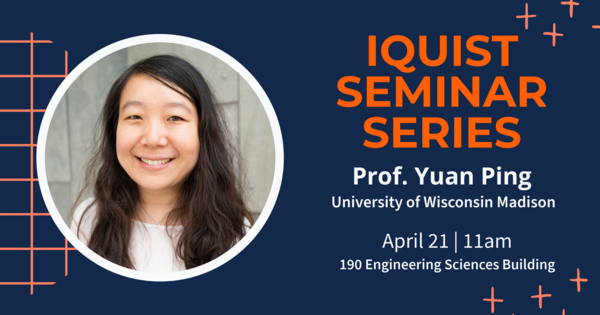
IQUIST Seminar: "First-Principles Theory for Excited-State Kinetics and Optical Readout of Quantum Defects," Yuan Ping, Associate Professor of Physics, University of Wisconsin-Madison
- Sponsor
- IQUIST
- Speaker
- Yuan Ping, Associate Professor of Physics, UW-Madison
- Contact
- Stephanie Gilmore
- stephg1@illinois.edu
- Phone
- 217-244-9570
- Views
- 28
- Originating Calendar
- IQUIST Seminar Series
First-Principles Theory for Excited-State Kinetics and Optical Readout of Quantum Defects
Abstract:
Point defects in semiconductors and insulators have emerged as leading solid-state platforms for quantum information science (QIS), offering atom-like spin states that can be initialized, manipulated, and read out optically. Yet a quantitative, predictive understanding of the underlying excited-state processes — radiative decay, nonradiative relaxation, intersystem crossing, and spin-photon coupling — has remained a major theoretical challenge. In this talk, I will present our development of first-principles computational platforms to address these processes systematically across a range of host materials.
I will first discuss how we benchmark and combine high-level electronic structure methods — many-body perturbation theory (GW/BSE), quantum defect embedding theory, and wavefunction-based quantum chemistry — to reliably predict the energetics, electronic structure, and optical spectra of spin defects in transition metal oxides, 2D materials, and diamond. I will then present our framework for computing radiative rates and phonon-assisted nonradiative rates from first principles, with particular attention to how electron-phonon coupling governs quantum yield and photoluminescence lifetime.
Next, I will discuss spin-orbit coupling and its role in driving intersystem crossing in NV centers in diamond and in deep defects in ZnO1 — the latter exhibiting unusually large SOC and suppressed Jahn-Teller distortion, which we show enables high-fidelity single-shot spin readout¹. Finally, by feeding all first-principles rates into quantum master equations, we predict ODMR contrasts in quantitative agreement with experiment for NV centers in diamond and spin defects in hBN. Together, these results establish a comprehensive computational framework for spin-photon interface properties5 with direct implications for quantum sensing, networking, and information processing
Bio: Yuan Ping received her B.Sc. degree from University of Science and Technology of China in 2007, Ph.D. from UC Davis (under Giulia Galli) in 2013, and materials postdoctoral fellow at Caltech (under William Goddard III) in 2016. Afterward she was an assistant and associate professor in chemistry and affiliated professor in physics at UC Santa Cruz. From July 2023, she moved to UW-Madison as associate professor in Materials Science and Engineering, and affiliated professor in physics and chemistry. Her research group focuses on developing first-principles many-body theory and open quantum dynamics for materials applications in quantum information science, spintronics, and energy conversion. Ping is a recipient of Alfred P. Sloan Research Fellow, NSF CAREER Award, Air Force Young Investigator Program award, and ACS COMP OpenEye Award. Ping is the lead of DOE Computational Chemical Science center (ADEPTs), the thrust lead of spin phenomena of DOE Computational Materials Science Center (NENPQ), as well as the thrust lead of the Energy Frontier Research Center (CHOISE).
To watch online, go to the IQUIST YouTube channel: https://www.youtube.com/channel/UCCzAySwQXF8J4kRolUzg2ww