- Sponsor
- IQUIST
- Speaker
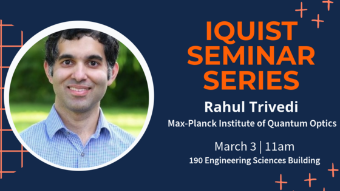
- Rahul Trivedi, Research Group Leader, Max-Planck Institute for Quantum Optics
- Contact
- Stephanie Gilmore
- stephg1@illinois.edu
- Phone
- 217-244-9570
- Views
- 11
- Originating Calendar
- IQUIST Seminar Series
"Quantum simulation of many-body physics in the presence of noise"
Abstract: Quantum computers offer a promising approach to simulating many-body physics. While a comprehensive set of algorithms for many-body problems has been developed for fully fault-tolerant quantum computers, current and next-generation platforms are expected to operate either directly on noisy physical qubits or with only moderate error correction. This raises a fundamental theoretical question: How well can quantum many-body problems be solved on noisy analog or digital quantum simulators?
In this talk, I will describe our efforts to understand the noise robustness of quantum simulators and to analyze meaningful notions of quantum advantage in simulating quantum many-body physics. In particular, I will show that, due to the quasi-locality properties of physically relevant models, their quantum simulation avoids worst-case error proliferation. This holds both when the target model is natively implementable on the simulator and when nontrivial problem-to-simulator mappings are required, such as Trotterization, Floquet–Magnus expansions, and perturbative expansion. Next, I will address the possibility of a quantum advantage for simulating noise-robust many-body systems, both with respect to noise-rate and system-size scaling, and connect this to the classical complexity of simulating geometrically local quantum circuits. I will conclude with an overview of some of our broader research activity in the field of many-body open quantum systems, both in connection to quantum information processing in the presence of noise as well as to further the fundamental understanding of many-body open systems.
Bio: Rahul Trivedi studied Electrical Engineering at the Indian Institute of Technology in Delhi and received his PhD from Stanford University in 2021. After a postdoctoral fellowship at the Max Planck Harvard Research Center for Quantum Optics, he became an Assistant Professor at the University of Washington. In 2024, he returned to MPQ as a tenured researcher, where he now leads a research group in the Theory Division. His research at MPQ spans quantum information, quantum optics, and quantum many-body physics, and is supported by the 2025 European Research Council (ERC) Starting Grant.