
GGIS Special Colloquium | Oceans beyond Oceans: How Shipping Decarbonization Reproduces Climate Coloniality
- Sponsor
- Department of Geography & GIS
- Speaker
- Kei Kato, Geography PhD student
- Cost
- This talk is free and open to the public with a virtual option.
- Registration
- Zoom RSVP
- Contact
- Geography & GIS
- geography@illinois.edu
- Views
- 93
- Originating Calendar
- Geography & Geographic Information Science
In recent years, the shipping industry has increasingly strategized to decarbonize itself. Conventionally, the industry has been understood as a hard-to-abate sector, one that is hard to decarbonize due to its heavy reliance on fossil fuels. In response to the global call for climate action, however, it has increased its engagement in decarbonization in recent years. For instance, in 2023, the UN International Maritime Organization established a decarbonization target to reduce the carbon intensity of international shipping by at least 40% by 2030 compared to 2008.
This dissertation will situate this recent trend within a broader historically formed entanglement between maritime logistics and climate coloniality. Climate coloniality is how colonial histories and present-day practices shape the causes, impacts, and proposed solutions to climate change. To confront climate coloniality and realize a more just world, it must address maritime logistics, as they play a central role in (re)producing it. As the primary mode of global trade for centuries, maritime logistics has contributed to an energy-intensive global economy, which, in turn, has led to environmental and labor exploitation in the Global South, Indigenous lands, and other socially marginalized regions. Though decarbonization and energy transition may seem like a fantastic undertaking, many critical thinkers, including scholars, have demonstrated that they typically rely on extractive practices that exploit humans and non-humans, thereby reproducing uneven geographies. Drawing on this insight, this study hypothesizes that decarbonization is the latest means by which maritime logistics reproduces climate coloniality.
The study will ask: How is the historically formed relationship between climate coloniality and maritime logistics reproduced through the latter’s decarbonization? To address this overarching question, the study will empirically focus on Green Shipping Corridors (GSCs). They are shipping routes where zero-emission technologies and the regulatory and economic frameworks that support them are developed. At the 26th United Nations Climate Change Conference (COP26) in 2021, 22 countries pledged to establish GSCs by signing the Clydebank Declaration. Since then, although none have been realized yet, more than 50 GSCs have been planned across the world, albeit dominantly in the Global North,
Ultimately, this study will contribute to the literature on climate coloniality. Although the literature is increasingly analyzing ocean spaces, much of it often treats oceans merely as sites of impact. Through the analysis of the reproduction of colonial capitalism through decarbonization in maritime logistics, this study will demonstrate how ocean spaces are active infrastructures that facilitate climate coloniality beyond ocean spaces themselves.
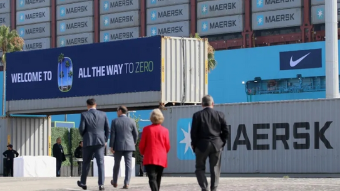
Above photo: DailyBreeze.com