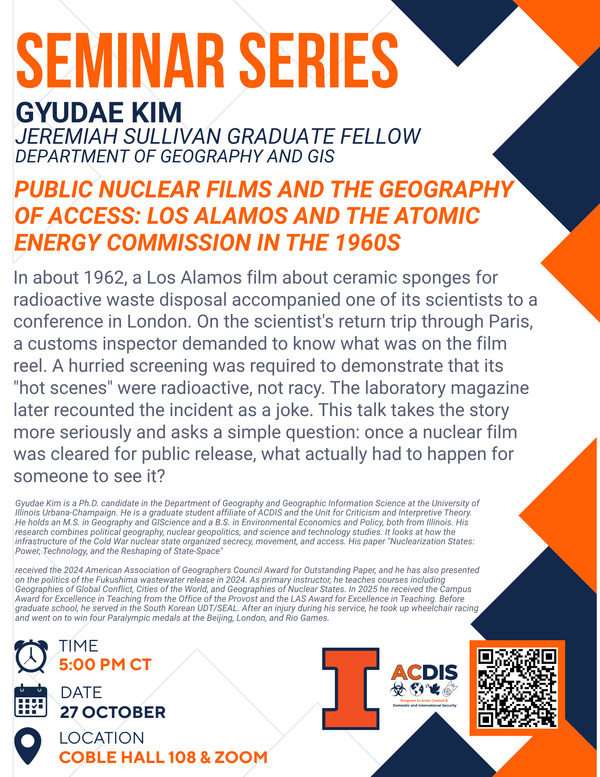
Seminar Series - Gyudae Kim, 2026 Jeremiah Sullivan Fellow
- Sponsor
- The Program in Arms Control and Domestic and International Security
- Contact
- ACDIS
- acdis@illinois.edu
- Views
- 161
- Originating Calendar
- ACDIS: Arms Control & Domestic and International Security
Public Nuclear Films and the Geography of Access: Los Alamos and the Atomic Energy Commission in the 1960s
Abstract:
In about 1962, a Los Alamos film about ceramic sponges for radioactive waste disposal was flown to London, where it followed its scientist to a conference. He came home by way of Paris, and a customs inspector wanted to know what was on the film can. It took a hurried screening to prove that the film's "hot scenes" were "radioactive, not racy." The laboratory's magazine told the story as a joke. It also raises the question this talk takes seriously: once a nuclear film was cleared for public release, what did it actually take for anyone to see it?
The talk compares two 1960s documents. One is a 1964 account of the Los Alamos Scientific Laboratory's documentary film group, which finished about one film a month, most of them classified. The other is the Atomic Energy Commission's 1966–67 professional film catalog, which offered more than 150 titles on loan. From the film group's years, only one Los Alamos title made it into that catalog. At Los Alamos, filmmakers fitted each film to viewers they imagined. A film had to be simple enough for a Congressman without scientific training and not so simple that it insulted a scientist. The AEC catalog was written for someone else: a representative of an organization who had to book weeks ahead, project the film properly, insure it, return it on time, and report on its use. The catalog sent borrowers to a library based on where they lived, not where the research was done. A Nevada group wanting a film about a nuclear rocket tested in Nevada applied to Berkeley. Borrowers overseas were sent to American embassies.
The talk argues that declassification made a film available. Access was a separate set of tasks that someone still had to perform, and borrowing, showing, and reusing footage each came with its own gatekeeper, route, and cost. For anyone thinking about nuclear transparency, this means that deciding what to release is only the start of deciding who can use it.
Bio:
Gyudae Kim is a Ph.D. candidate in the Department of Geography and Geographic Information Science at the University of Illinois Urbana-Champaign. He is a graduate student affiliate of ACDIS and the Unit for Criticism and Interpretive Theory. He holds an M.S. in Geography and GIScience and a B.S. in Environmental Economics and Policy, both from Illinois. His research combines political geography, nuclear geopolitics, and science and technology studies. It looks at how the infrastructure of the Cold War nuclear state organized secrecy, movement, and access. His paper "Nuclearization States: Power, Technology, and the Reshaping of State-Space"
received the 2024 American Association of Geographers Council Award for Outstanding Paper, and he has also presented on the politics of the Fukushima wastewater release in 2024. As primary instructor, he teaches courses including Geographies of Global Conflict, Cities of the World, and Geographies of Nuclear States. In 2025 he received the Campus Award for Excellence in Teaching from the Office of the Provost and the LAS Award for Excellence in Teaching. Before graduate school, he served in the South Korean UDT/SEAL. After an injury during his service, he took up wheelchair racing and went on to win four Paralympic medals at the Beijing, London, and Rio Games.