GGIS Defense | Impacts of retrogressive thaw slumps on vegetation succession in northern Alaska
- Sponsor
- Department of Geography & GIS
- Speaker
- Emma Hall, Geography PhD Candidate
- Cost
- This dissertation defense is free and open to the public with a Zoom option
- Registration
- Join via Zoom
- Contact
- Geography & GIS
- geography@illinois.edu
- Originating Calendar
- Geography & Geographic Information Science
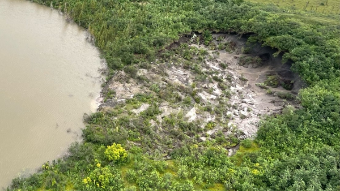
Arctic landscapes are undergoing rapid transformation as rising global temperatures destabilize ice-rich permafrost, triggering widespread terrain collapse and accelerating the formation of retrogressive thaw slumps (RTSs). RTS abundance and size have increased markedly across the pan-Arctic , where frequency and intensity of expansion rates vary with climate, lithology, and ground-ice content, complicating predictions of how these features expand over space and time.
As RTSs expand laterally across the landscape, they mobilize stores of previously frozen soil carbon and nutrients, reshaping local topography and hydrology, creating a unique microtopography that may influence long-term trajectories of vegetation recovery over time (i.e., succession). However, successional patterns following RTS activity remain unclear, where increased plant growth may potentially offset disturbance-driven carbon losses. My overarching hypothesis is that this heterogeneity, combined with regional gradients in climate and slump morphology, influences plant successional patterns.
- Chapter 1 predicts RTS expansion and projects future change trajectories across Alaska.
- Chapter 2 uses the resulting microtopography to predict plant growth patterns, and
- Chapter 3 combines results from Chapters 1 and 2 to determine how vegetation succession varies across thaw slumps, with implications for RTS ecosystem function and carbon storage.
Collectively, this dissertation establishes that RTS dynamics and vegetation succession are coupled through climate-mediated feedbacks operating across microsites and regions. Although recovering vegetation can restore aboveground carbon stocks to undisturbed levels, the magnitude of RTS disturbances under continued climate warming will mobilize quantities of carbon greater than what vegetation can recover over the observed successional timeframe. Aboveground recovery offsets only ~2% of carbon emissions following RTS disturbance, leaving these features as net carbon sources. My dissertation resolves that the fine-scale successional and microtopographic dynamics characterized here are essential for accurately projecting the net carbon balance of permafrost regions in a warming Arctic.