- Sponsor
- IQUIST
- Speaker
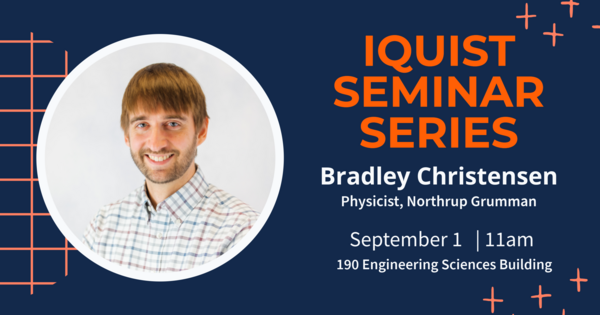
- Bradley Christensen
- Contact
- Stephanie Gilmore
- stephg1@illinois.edu
- Phone
- 217-244-9570
- Views
- 61
- Originating Calendar
- IQUIST Seminar Series
"Amorphous Defects and Superconducting Control of Scaled Quantum Systems"
Abstract: Superconducting qubits offer a promising path to large-scale quantum computing systems. However, most industry platforms use a brute force approach to control hardware, where multiple room temperature lines and microwave sources are required per qubit. Northrop Grumman has developed an extremely energy efficient superconducting logic family, Reciprocal Quantum Logic (RQL), which allows for qubit circuit control in a bonded assembly. This control methodology only requires hardware to control the digital logic, significantly reducing overhead costs. In my talk, I will provide a basic introduction to the unique concepts that underlie our technologies. I will then describe how we use RQL to perform microwave-free universal control of superconducting dual-rail qubits, including our fast flux-qubit-based readout. Finally, I will discuss how we characterize a major source of infidelity: amorphous defects, or two-level systems (TLS), located in and near the Josephson junction.
Bio: Bradley Christensen is a deputy chief engineer in the Microelectronics Design and Application business area at Northrop Grumman. His primary development areas are strongly-coupled two-level systems, coherence times of quantum circuits, and ionizing radiation interactions with superconducting devices. Before working at Northrop, Bradley was an Intelligence Community Postdoctoral Fellow under Prof. Robert McDermott at the University of Wisconsin-Madison, where he researched upsets of superconducting qubits from ionizing radiation, novel readout circuits, and SFQ control of qubits. For his PhD, Bradley studied under Prof. Paul Kwiat at the University of Illinois at Urbana-Champaign, where he performed experiments of quantum nonlocality and made significant contributions to the strong loophole-free test of local realism.