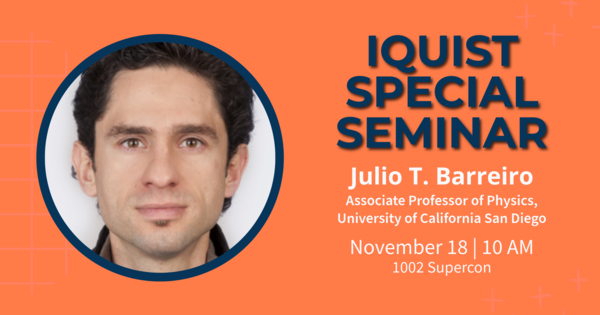
IQUIST Special Seminar: "Quantum Science and Technology with Ultracold Strontium," Julio T. Barreiro, University of California San Diego
- Sponsor
- IQUIST
- Speaker
- Julio Barreiro
- Contact
- Stephanie Gilmore
- stephg1@illinois.edu
- Phone
- 217-244-9570
- Views
- 76
- Originating Calendar
- IQUIST Seminar Series
"Quantum Science and Technology with Ultracold Strontium"
Abstract: Strontium’s two-electron structure offers ultranarrow optical transitions, a nonmagnetic ground state and, in its fermionic isotope, a large nuclear spin, making it a versatile atom for quantum science and technology. I will show how my group uses engineered light to trap, couple and probe strontium atoms for two main research thrusts.
Nature computes with fermions, yet today’s quantum computers speak the language of qubits. Toward fermionic quantum computing, we loaded deeply degenerate strontium-87 Fermi gases into tweezer arrays (T/T_F ≈ 0.015) at a turquoise clock-magic wavelength we measured near 497 nm. For quantum simulation, we realized a two-dimensional fermionic spin-momentum lattice with tunable gauge flux in synthetic space.
We are also bringing bosonic strontium onto integrated photonics, first trapping atoms 300 nm from an optical nanofiber. Near surfaces, vacuum fluctuations matter: holding atoms 189 nm from a dielectric, we have directly measured the Casimir–Polder shift in the intermediate regime, in agreement with QED calculations.
Looking ahead, we aim to realize a fermionic variational quantum eigensolver for molecular ground-state energies, with Fermi statistics guaranteed by hardware, and to extend synthetic-dimension simulations to interacting fermions. On the technology side, mapping how Casimir–Polder forces depend on surface materials and geometry will inform atomtronic circuits and chip-scale matter-wave gyroscopes.
Bio: Julio T. Barreiro is an Associate Professor of Physics at the University of California San Diego, where he leads a lab working on quantum science and technology with ultracold strontium atoms. Barreiro earned his Ph.D. from the University of Illinois at Urbana-Champaign. He was then a Marie Curie Fellow at the University of Innsbruck and a Max Plank Fellow at the Max Planck Institute of Quantum Optics and LMU Munich, before joining UC San Diego in 2014.
IQUIST is committed to providing a safe, inclusive, and respectful environment for all participants at our sponsored events. By attending an IQUIST event, you agree to abide by this Code of Conduct.
- Expected Behavior: Treat all attendees, speakers, staff, and volunteers with civility and professional respect. Engage in constructive, open inquiry and scholarly debate that values diverse perspectives.
- Prohibited Behavior: Harassment, discrimination, bullying, intimidation, or disruptive actions of any kind will not be tolerated. This includes inappropriate verbal comments, unwelcome physical contact, or intentional disruption of presentations.
- Enforcement: The organizers reserve the right to remove any participant who violates these guidelines from the event without warning.
- Reporting: If you experience or witness behavior that violates this policy, please report it immediately to the event organizers.
This policy operates in conjunction with broader university guidelines including the GCOE Professional Expectations, the University Code of Conduct, and the Campus Administrative Manual.