Dynamics and Light: A New Perspective on Simulating the Universe
- Sponsor
- Department of Astronomy
- Speaker
- Professor Kirk Barrow
- Contact
- Daniel Franco
- danielf9@illinois.edu
- Phone
- 217-300-6769
- Originating Calendar
- Astronomy Colloquium Speaker Calendar
As new observatories are built to peer more deeply into our Universe, our community is challenged to develop theoretical and modeling frameworks capable of characterizing and interpreting what may become humanity’s greatest astronomical discoveries. My research addresses this need by generating detailed, state-of-the-art synthetic observations from hydrodynamic cosmological simulations and using them to study the assembly of galaxies in the early Universe. By connecting observations and theory, we can gain new insights into how galaxies form and evolve.
Because the dynamics of stars and gas within galaxies are governed by their surrounding dark matter halos, it is possible that dark matter dynamics also influence the redshift and mass evolution of galaxies. We have re-examined the spherical collapse theorem and developed a new framework for studying dark matter that relaxes many traditional geometric assumptions. Using this framework, we identify new trends in dark matter halo evolution—including densification and spin evolution—that have not previously been reported. These findings may have important implications for understanding galaxy formation and evolution.
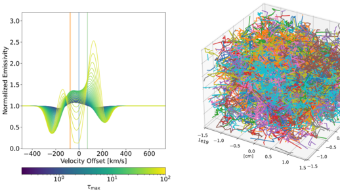
To help connect these theoretical developments to observations, I also highlight recent advances we have made in radiative transfer modeling, including improved treatments of emission-line profiles, dust, and polarization.