Memorias de la Mujer Lotina: Arpilleras, Women, and Coal in Chile
- Sponsor
- Center for Latin American and Caribbean Studies, The Climate Jobs Institute, Urban and Regional Planning, Krannert Art Museum
- Originating Calendar
- Center for Latin American and Caribbean Studies (CLACS)
Memorias de la Mujer Lotina: Arpilleras, Women, and Coal in Chile
Exhibition: February 26 – September 5, 2026
Main Level | Contemporary Gallery
Krannert Art Museum, 500 E Peabody Dr, Champaign, IL 61820Weeklong Residency: March 30 – April 4, 2026
University of Illinois Campus
See Public Events belowThis exhibition and residency extend CJI’s commitment to documenting and strengthening coal communities through the Illinois Coal Workers & Communities Listening Project. By connecting grassroots leaders from Chile’s Biobío coal basin with workers and families in Illinois, the program demonstrates what international solidarity can look like in practice.
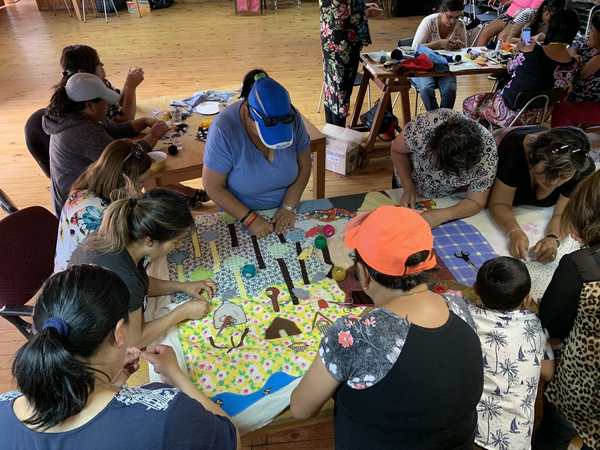
Women create an arpillera at a workshop in Lota, Chile. 2020. Photo courtesy of Magdalena Novoa. Why this Matters
Coal communities across the globe face shared challenges: economic displacement, environmental harm, and the struggle to preserve cultural identity as industries decline.
In Illinois, the Climate Jobs Institute is working with workers, families, and local leaders to ensure that transition policies are informed by lived experience. In Lota, Chile, women have already experienced the transition away from coal, using collective art-making and organizing as a resource for social and economic development. Their art and activism has influenced urban planning, heritage preservation, and public recognition of their community’s history.
This collaboration creates space for shared learning grounded in working-class experience — centering women’s leadership, cultural memory, and community-driven economic renewal.
The Exhibition
This exhibition showcases a long-term collaboration between a community organization in Chile—Mesa Ciudadana de Patrimonio, Cultura y Turismo de Lota—and scholar Magdalena Novoa. The project uses the Chilean textile craft called arpillera made by women in Chile’s southern coal basin region of Biobio to create counter-narratives of their cities’ urban history from women’s perspectives and to influence historical preservation planning and policy.
Noelia Espinoza, Elizabeth Aguilera (Mesa President), and Magdalena Novoa sit in front of an arpillera. 2020. Photo courtesy of Magdalena Novoa. Arpilleras are a radical feminist practice of storytelling and protest that became prominent in Chile during the Pinochet dictatorship (1973–1990) when women used them to denounce their relatives’ disappearances and political violence. Today, women experiencing marginalization continue to create arpilleras depicting poverty, gender violence, and survival strategies. The arpilleras have colorful stitching, applique, and embroidery; and they are created in group sessions where women share experiences, talking as they sew.
“Patrimonio Inmaterial” arpillera by Elizabeth Aguilera. 2020. Photo courtesy of Magdalena Novoa. Featuring more than a dozen textiles and documentary footage contextualizing their significance, the exhibition will include a monumental sixteen-foot-long arpillera representing the city of Lota, made by fifty-two women aged 14 to 92. With Lota’s nomination to the list of UNESCO World Heritage sites, this work has helped influence decisions about planning and preservation in their city by making visible how official heritage narratives have concealed women’s experiences of place.
During this collaborative and performative cartography of memory, the women embarked on a process of co-producing knowledge in an accessible format for participants and the general public, facilitating a process of advocacy by participants themselves.
Guided tours are available upon request. Contact Magdalena Novoa mnovoa@illinois.edu.
Curated by Magdalena Novoa, Assistant Professor of Urban and Regional Planning, with Amy L. Powell, Curator of Modern and Contemporary Art, and Allyson Purpura, Senior Curator and Curator of Global African Art


