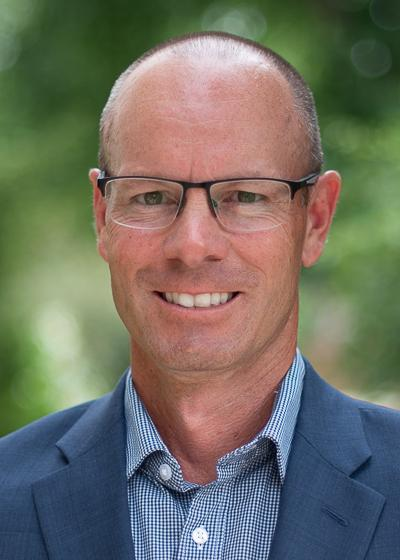
Special Joint Seminar Speaker: Dr. Paul Markowski, Penn State University
- Sponsor
- Professor Jeff Trapp
- Views
- 41
- Originating Calendar
- CliMAS Colloquia
A new pathway for tornadogenesis exposed by numerical simulations of supercell storms in turbulent environments
A simulation of a supercell storm produced for a prior study on tornado predictability is reanalyzed for the purpose of examining the fine-scale details of tornadogenesis. It is found that the formation of a tornado-like vortex in the simulation differs from how such vortices have been understood to form in previous numerical simulations. The main difference between the present simulation and past ones is the inclusion of a turbulent boundary layer in the storm’s environment in the present case, whereas prior simulations have used a laminar boundary layer.
The turbulent environment contains significant near-surface vertical vorticity (~0.03 s–1 at z = 7.5 m), organized in the form of longitudinal streaks aligned with the southerly ground-relative winds. The vertical vorticity streaks are associated with corrugations in the vertical plane in the predominantly horizontal, westward-pointing environmental vortex lines; the vortex-line corrugations are produced by the vertical drafts associated with coherent turbulent structures aligned with the aforementioned southerly ground-relative winds (longitudinal coherent structures in the surface layer such as these are well-known to the boundary layer and turbulence communities). The vertical vorticity streaks serve as focal points for tornadogenesis. The so-called "baroclinic mechanism" of tornadogenesis is absent in the simulations, even though the supercell morphology appears to be similar to simulated supercells in which the baroclinic mechanism is operating. I will try to make sense of what all of this might mean. Time-permitting, I will share some musings on non-equilibrium lower boundary conditions and their potential impact on supercells and tornadoes.
Dr. Markowski is the Distinguished Professor of Meteorology and Department Head, Department of Meteorology and Atmospheric Science, Penn State University
***Special ZOOM link for this seminar: https://go.ncsa.illinois.edu/NCSAColloquium