ISGS Seminar | Highlights of a New Quaternary (Surficial) Geology Map for Illinois
- Sponsor
- Illinois State Geological Survey
- Speaker
- David A. Grimley
- Views
- 19
- Originating Calendar
- Illinois State Geological Survey Seminars
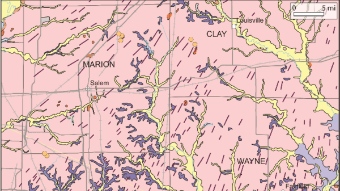
Abstract: This presentation will highlight the findings of a 5-year project (2020-2025) to update the 1:500,000-scale Quaternary Deposits map of Illinois. Quaternary deposits, covering > 90 % of Illinois, consist predominantly of glacial sediments (till, ice-contact sediment, outwash, loess, lake sediment, peat), but also include interglacial deposits, paleosols, post-glacial alluvium, colluvium, and anthropogenic fill. These sediments are societally important for groundwater, waste siting, sand & gravel resources, agriculture, seismic hazards, slope stability, engineering projects, and watershed ecology. The most recent comprehensive map of such deposits by the ISGS was completed in 1979 (Lineback and others), with many detailed surficial maps produced by ISGS in the past four decades. The new statewide map was constructed digitally (at 1:62,500 – 1:100,000 scale) using GIS overlays of numerous surficial geologic maps, lidar topography, USDA soil parent materials, archived geologic field notes, aerial photographs, and other data. Subsurface borehole records (water wells, engineering data) or samples were also examined in areas of limited mapping. Some new geophysical data (electrical resistivity), drilling, geochronology, particle size, and compositional data also greatly helped to guide mapping.
The new mapping features several significant changes in comparison to the Lineback (1979) map: (1) the addition of Wisconsin Episode ice-walled lake deposits on moraines of northeastern Illinois (contributed by B.B. Curry); (2) significant modifications to the extent and limits of Illinois Episode glacial till units in western and southern Illinois, based on geomorphology, particle size, geochemical and magnetic data; (3) introduction of two new Illinois Episode till members and consolidation of others; (4) recognition of till units in north-central Illinois as Illinois Episode (Berg et al., 1985); (5) significant increases in mappable anthropogenic deposits; (6) near-surface Paleozoic and Mesozoic bedrock are distinguished; (7) new mapping of moraine crests, glacial lineations, eskers, ice margins, loess thickness, and key field sites ---intended as overlays on final published map; (8) new mapping extends 10 miles into adjacent states to aid long-term goal of seamless national map and to show full width of major river valleys.
Bio: David A. Grimley is a Principal Research Scientist, Quaternary Geologist, at the Illinois State Geological Survey, where he has worked since 1995. His undergraduate degree is from Colgate University and PhD is from the Department of Geology at UIUC. His current position involves various aspects of Quaternary (glacial-interglacial) mapping and research, mainly in Illinois and the central USA region. His research interests and expertise include surficial geologic mapping, loess-paleosol sequences, Illinois and pre-Illinois Episode glaciations, Quaternary gastropods and paleoenvironments, paleoclimate, soil magnetic properties, and soil-vegetation relations. As an Adjunct Professor, he regularly collaborates with faculty and students at the Department of Earth Science and Environmental Change. Currently funded projects include subsurface mapping of Illinois Episode and pre-Illinois Episode deposits in Illinois and a four-state Quaternary Stratigraphic Correlation project in the glaciated Midwest East.
To attend online, contact info@isgs.illinois.edu for a Teams link.