ISGS Seminar | Geochemistry of Landscapes Covered by Glacially Crushed Debris
- Sponsor
- Illinois State Geological Survey
- Speaker
- Dr. William W. Shilts
- Originating Calendar
- Illinois State Geological Survey Seminars
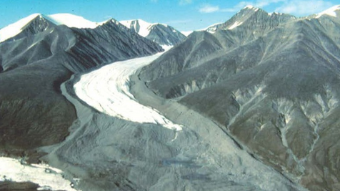
Abstract: Glacial dispersal is a term describing the processes through which debris is created and picked up by glaciers, transported in, on or under them, and ultimately released from them some distance from its origin. The size distribution of mineral or rock grains in glacial sediments, and therefore, the geochemical characteristics of different size fractions is dictated by the physical properties of the various components. These properties govern how effectively the components will be comminuted by glacial erosion and transport. Because glaciers erode fresh, unweathered bedrock and glacial sediments often contain easily weathered (labile) components such as sulphides and carbonates. To be able to interpret the patterns of geochemical dispersal effectively in glaciated terrain, it is imperative to recognize the possible geochemical effects of chemical partitioning by grain size and the effects of weathering on labile components. Sample populations and analytical techniques must be appropriate for depicting glacial dispersal so that they do not produce results that merely represent artifacts of sample-to-sample inconsistency in textural variation or weathering status. Along with the precautions mentioned above, samples must ensure that sediment facies sampled must be properly identified and that the stratigraphic position of the unit sampled must be understood. Typically, glacial dispersal produces distinct spatial patterns, such as ribbon- or fan-shaped distributions extending from a source area. Within these dispersal trains, geochemical concentrations are usually highest near the source and decrease exponentially with distance. However, large-scale processes like ice streaming can transport material over long distances without a clear decline in concentration, potentially masking local geochemical signals. Additionally, sediments may represent a mixture of multiple overlapping dispersal events at different spatial scales. It is the task of the explorationist to determine and distinguish, considering all the caveats and principles mentioned above, what the economic significance of a sample is within the context of the vertical or area geochemical pattern of which it is a component.
Bio: William W. Shilts, Ph.D., a native of Hudson, Ohio, was the founding executive director of the Prairie Research Institute after leading the effort in 2008 to transfer the scientific surveys from state agencies to the University of Illinois. Notable accomplishments under his leadership include working with the Illinois Department of Transportation to bring the Illinois State Archaeological Survey (ISAS) into the Institute; leading efforts to pass legislation in 2013 recognizing ISAS and creating seven state scientist positions; and creating the PRI Lightning Symposium for staff to share their work with colleagues. From 1995 to 2008, Shilts was Chief of the Illinois State Geological Survey (ISGS). During that time, he made detailed, three-dimensional geologic mapping a priority and strengthened efforts to create an energy program. Before becoming ISGS Chief, Shilts worked for 30 years as a research scientist for the Geological Survey of Canada, leading studies in the fields of exploration and environmental geochemistry, glacial sedimentology and stratigraphy, permafrost and patterned ground, atmospheric contaminants (mercury and acid rain) in lakes, and the impacts of historic and prehistoric earthquakes on lakes. Shilts has been a proponent for providing clear explanations of science to the lay public and for the importance of utilizing earth science as an important component for assuring responsible economic development and environmental security in modern societies.