Seminar Speaker: CliMAS Graduate Students, Alia Nasution and Paul Romano
- Sponsor
- Professor Jeff Trapp
- Views
- 8
- Originating Calendar
- CliMAS Colloquia
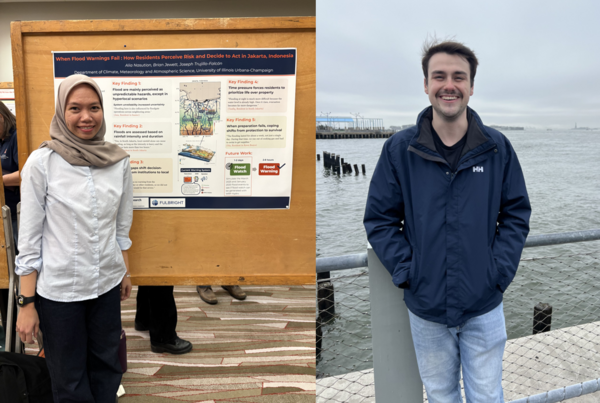
Alia Nasution:
Resident Perspectives on Flood Warning in Jakarta, Indonesia, and the Potential for Forecast-Based Flood Watch using WRF-Hydro
Jakarta, the former capital of Indonesia, has experienced frequent and severe flooding for many years, making an effective flood warning system essential. To better understand the current system and residents’ perspectives, we conducted qualitative research. We found that Jakarta’s flood warning system remains largely observation-based, relying on upstream river water levels to trigger alerts once threshold conditions are reached. While this method supports immediate warning, it provides only limited lead time for residents and emergency managers.
Motivated by these findings and inspired by the tiered flood warning approach used in the United States, we explored a forecast-based Flood Watch concept for Jakarta. Using WRF-Hydro, we generated rainfall forecasts and simulated river streamflow to estimate flood response in advance. Our results show that streamflow responds to rainfall with a predictable lag, which can help indicate when peak flow may occur. This suggests that a forecast-based Flood Watch could provide earlier warning and support flood preparedness in Jakarta.
Paul Romano:
Complex Morphology of Convection: Radar Climatology and Cell Tracking of Convective Systems Over Chicago and Phoenix
Urban areas are well known to change the local environment through the formation of heat islands, increased aerosol concentration, and increased surface roughness. If we dig deeper into the literature, we find arguments for storms strengthening due to the heat island effect, while others suggest that various processes, such as increased friction, weaken convection in urban environments. To address these uncertainties, we examined the urban influence on convection through an observational and climatological approach, utilizing NOAA WSR-88D radar data and surface temperature observations from Chicago and Phoenix. These two cities were chosen for their differences in climate and local geography, allowing for a comparison of how urbanization impacts convection across environments. Over a three-year period, from 2021 to 2023, we analyzed events where convective storms above 50 dBZ entered a 50-kilometer radius ring from the city center. For each storm there were three critical points for measurement: (1) as the storm enters the ring, (2) over the city center, and (3) when the storm exits the ring. At each of these points, the storm is measured by its maximum dBZ, length, width, and the area of the 50+ dBZ core. This allows cells to be tracked and measured as they traverse the city. After cleaning, we retained 164 storms in Chicago and 93 storms in Phoenix. Reflectivity was converted from dBZ to linear Z for statistical testing. In Chicago, we found a pattern of storms increasing in both area and reflectivity over the city center, followed by a decrease upon exiting. Phoenix showed a similar but less pronounced signal. In both cities, storms that fully traverse the ring are significantly stronger over the urban core than storms that only partially interact with the city. To characterize the thermal environment preceding each storm, we computed the 24-hour mean urban heat island intensity ending one hour before each storm phase using METAR data: KORD minus KRFD for Chicago and PHX minus BXK for Phoenix. UHI values are predominantly positive across all phases and both cities, confirming a persistent urban thermal excess before convective events. We also stratified storms by day of week and found that weekend storms in Chicago are significantly stronger upon leaving the city compared to weekday storms, while in Phoenix, weekend storms show significantly higher reflectivity over the city center. These patterns may reflect the weekly cycle of urban emissions and activity, though further investigation is needed. Overall, these findings suggest that the urban environment plays a measurable role in modifying thunderstorm properties during transit, with the clearest signal being storm enhancement over the city center. Future work includes incorporating aerosol concentration data from nearby EPA monitoring sites, investigating whether large and small storms respond differently to the urban environment, and developing automated storm tracking methods to expand the sample size beyond what manual radar analysis allows.