Exploring Cosmic Noon With Line Intensity Mapping
- Sponsor
- Department of Astronomy
- Speaker
- Dr. Anthony Pullen
- Contact
- Daniel Franco
- danielf9@illinois.edu
- Phone
- 217-300-6769
- Views
- 96
- Originating Calendar
- Astronomy Colloquium Speaker Calendar
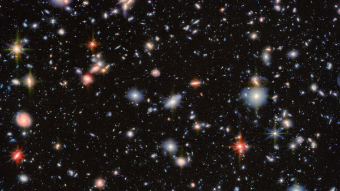
The period 2-3 billion years after the Big Bang, known as “cosmic noon,” is the peak of star formation and supermassive black hole growth. Much of the current effort to characterize this epoch uses data from astronomical observatories such as the James Webb Space Telescope. These observatories hope to better characterize the feedback mechanisms within galaxies that caused star formation to peak during this period as well as how star formation and supermassive black hole growth are connected. However, the bulk of star formation is known to take place outside the brightest galaxies that are detected by these galaxy surveys. Line intensity mapping (LIM) observes the aggregate emission from fainter galaxies over much larger volumes, which could reveal the full picture of star formation across cosmic history. In this talk we will discuss our efforts to improve both modeling of the line luminosities for realistic galaxies and the implementation of cutting-edge inference methods to exploit the full potential of upcoming LIM surveys.