- Sponsor
- Russian, East European, and Eurasian Center, co-sponsored by Women and Gender in Global Perspectives Program
- Speaker
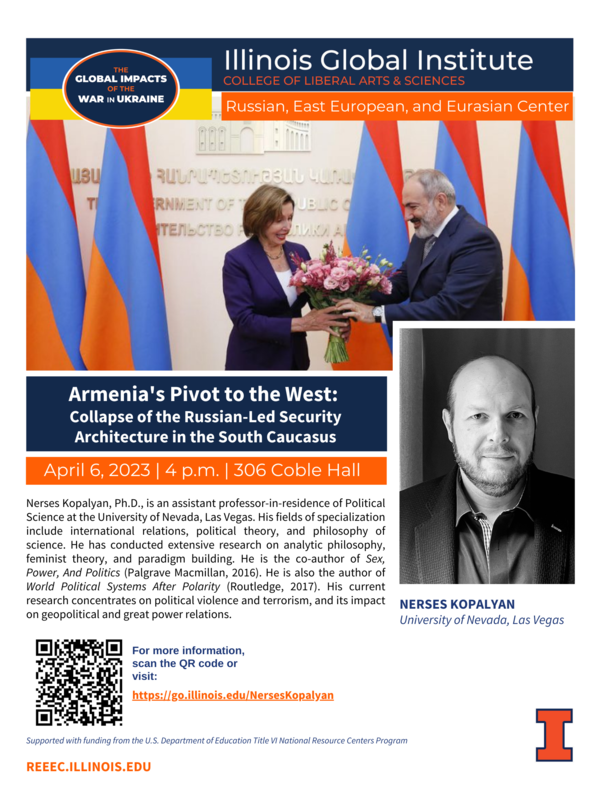
- Nerses Kopalyan is an associate professor-in-residence of political science at the UNLV. His fields of specialization include international relations, polarity and superpowers, political theory, and philosophy of science.
- Contact
- Maureen Elizabeth Marshall
- reec@illinois.edu
- Phone
- 217-333-1244
- Views
- 91
- Originating Calendar
- Center for the Study of Global Gender Equity
Russia's power and influence in the South Caucasus has exponentially diminished due to its invasion of Ukraine and the subsequent failures of securing a swift outcome. As the entirety of the resources of the Russian state is being allocated to the Ukrainian front, the peripheries of the post-Soviet Space, traditionally placed within Russia's sphere of influence, are dealing with the consequences of Russia's decline. In the South Caucasus, the Russian-led security architecture collapsed after the 2020 Nagorno-Karabakh War, as Azerbaijan initiated hostilities against Armenia. Russia's failure to meet its obligations as the security guarantor of Armenia, and Russia's subsequent alliance with Azerbaijan prior to its invasion of Ukraine, has altered the reconfigurations in the region. Armenia, having democratized after the 2018 Velvet Revolution, has sought a pivot to the West, while a new Russo-Azerbaijani axis has formed to both curtail Armenia's pivot as well as keep the West out of the South Caucasus. With the regional hegemon in decline, and the West's attempt to fill this power vacuum, what are the trajectories of instability, democratization, and potential developments for the region?