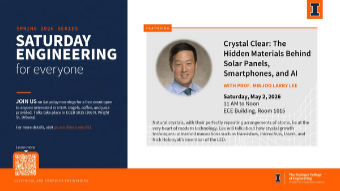
Crystal Clear: The Hidden Materials Behind Solar Panels, Smartphones, and AI
- Sponsor
- Department of Electrical & Computer Engineering
- Speaker
- Larry Lee, Intel Alumni Endowed Faculty Scholar, Director of HMNTL, Professor in ECE
- Contact
- Todd Sweet
- tmsweet@illinois.edu
- Views
- 106
- Originating Calendar
- Illinois ECE Saturday Engineering for Everyone
Overview: Natural crystals, with their straight lines and smooth facets, have long fascinated people. Recently, it was even found that chimpanzees prefer crystals to duller, more common rocks. But beyond their beauty, crystals, with their perfectly repeating arrangements of atoms, lie at the very heart of modern technology.
More than a century ago, inventors discovered that naturally occurring crystals like galena and quartz could detect radio signals and keep precise time. With the advent of quantum mechanics, scientists finally understood why crystals behave the way they do. That understanding sparked a revolution: instead of relying on nature, researchers began learning how to grow crystals in the laboratory with extraordinary purity and control.
I will talk about how crystal growth techniques unleashed innovations such as transistors, microchips, lasers, and Nick Holonyak’s invention of the LED. I’ll then highlight how work by Illinois alumni Russ Dupuis and Al Cho made it possible to engineer crystals layer by layer at the nanoscale. Finally, I’ll look ahead to how crystal engineering continues to shape fields such as artificial intelligence and quantum technology.
Bio: Minjoo Larry Lee is a Professor of Electrical and Computer Engineering at the University of Illinois Urbana-Champaign, where he is also the Director of the Holonyak Micro and Nanotechnology Laboratory. He teaches a class where students get to try their hand at making their own microchips in a cleanroom. His research focuses on growing thin layers of crystals for applications including transistors, solar cells, lasers, and quantum computing.