February NCSA Colloquium: Salman Habib
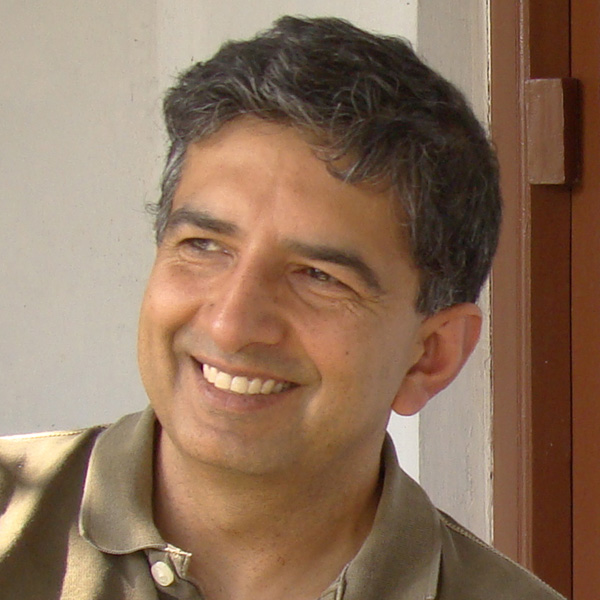
- Sponsor
- National Center for Supercomputing Applications and The Center for AstroPhysical Surveys
- Registration
- No registration needed. Click here to download the calendar invite.
- Contact
- Aliya Yabekova
- aliya@illinois.edu
- Originating Calendar
- NCSA Colloquium Series
National Center for Supercomputing Applications (NCSA) and The Center for AstroPhysical Surveys (CAPS) are hosting Salman Habib as part of the monthly NCSA Colloquium Series and invite everyone to participate in the February session.
Bio: Salman Habib (Ph.D., Physics, University of Maryland, 1988) is the CPS Division Director and an Argonne Distinguished Fellow. He holds a joint position in HEP Division and appointments at UChicago and Northwestern. Habib is a Fellow of the American Physical Society and an IEEE/CS Sidney Fernbach awardee. His interests range from quantum field theory to the formation and evolution of cosmological structures. Habib has been deeply involved in HPC applications, including advanced statistics and machine learning, to problems in the physical sciences, including beam dynamics, nonequilibrium quantum and classical field theory, quantum dynamical systems, and cosmic structure formation.
Title: Supercomputing at the Crossroads
Abstract: The nature of supercomputing has evolved over time driven by changes originally in general-purpose computational architectures, and now more and more by constraints such as the power wall and priorities determined by large-scale AI applications and not by conventional high-performance computing imperatives. At the same time, the use cases for supercomputing are also becoming more diverse including nontraditional applications in data-intensive computing and at the confluence of high-performance computing and a broad portfolio of rapidly impactful AI-driven workflows. In this talk, I will discuss possible near-future consequences for computing facilities aiming to achieve new classes of scientific breakthroughs enabled by next-generation supercomputing.