Feb 16, 2026 5:00 pm
- Sponsor
- The Program in Arms Control and Domestic and International Security
- Contact
- ACDIS
- acdis@illinois.edu
- Views
- 11
- Originating Calendar
- ACDIS: Arms Control & Domestic and International Security
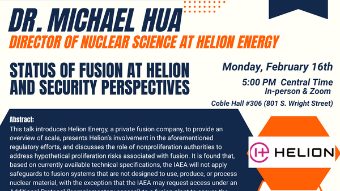
- AbstractFusion is nearing commercial deployment. The number of private fusion companies is increasing, governments are investing more in fusion research, and States are committing to global increases in fission- and fusion-based electricity sources to address global needs associated with climate change. As fusion yields increase and fusion machines expand beyond just a few research and development laboratories, the question arises as to the role of the nonproliferation and dual-use export control regimes in controlling fusion technology. To this end, the International Atomic Energy Agency (IAEA) is developing several technical documents (TECDOCs) on fusion safety and regulation; and hosting workshops and technical/ consultant’s meetings on fusion design and safety considerations. This talk introduces Helion Energy, a private fusion company, to provide an overview of scale, presents Helion’s involvement in the aforementioned regulatory efforts, and discusses the role of nonproliferation authorities to address hypothetical proliferation risks associated with fusion. It is found that, based on currently available technical specifications, the IAEA will not apply safeguards to fusion systems that are not designed to use, produce, or process nuclear material, with the exception that the IAEA may request access under an Additional Protocol (‘complementary access’) to a fusion plant to assure the absence of undeclared nuclear material and activities at such a plant. In addition to complementary access, tools exist to manage the proliferation risks from fusion. These tools include export controls and safeguards applicable to nuclear material, facilities, and activities (e.g., reprocessing and enrichment), which may be required to effectively generate special fissionable material from fusion. This talk and paper then discuss avenues for future work, such as technical research into the merits of wide area environmental sampling.BioDr. Michael Hua is Director of Nuclear Science at Helion Energy, a fusion energy company developing pulsed fusion generators to deliver commercial electricity. He leads a multidisciplinary organization spanning Nuclear Engineering, Materials Science, Fuel-Cycle (Chemical) Engineering, Radiation Safety, and Advanced Concepts, supporting the development and scale-up of fusion power systems. His work sits at the intersection of deep technical engineering and strategic leadership. In parallel, he plays a key role in regulatory strategy and external engagement, helping shape frameworks for how fusion energy is governed in the United States and abroad. Before Helion, Michael conducted research at Los Alamos National Laboratory and worked as an analyst in the US Intelligence Community. He earned his Ph.D. in nuclear engineering from the University of Michigan as a National Science Foundation Fellow. He has written a chapter on nonproliferation and fusion for an IAEA technical series, represented the fusion industry at DOE-led workshops, and has been a part of INMM panels on fusion.