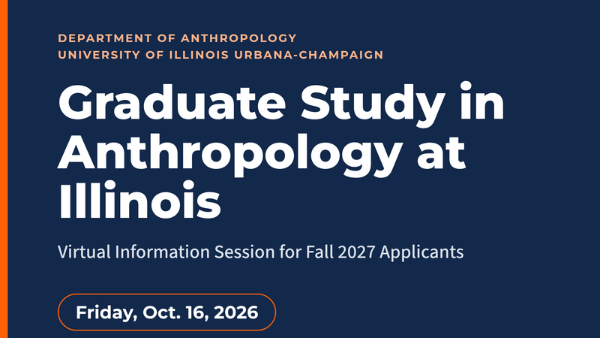
Graduate Information Session: Study Anthropology at Illinois
Oct 16, 2026 1:00 - 2:00 pm
- Sponsor
- Department of Anthropology
- Registration
- Registration
- Contact
- Dr. Jeffrey Martin
- jmart@illinois.edu
- Views
- 19
The University of Illinois Urbana-Champaign offers doctoral training in archaeology, biological, sociocultural, and linguistic anthropology.
If you are considering applying, join our virtual information session on Friday, October 16, from 1:00 to 2:00 PM CT. You can meet current faculty and graduate students, learn about the graduate program and how to apply, and ask any questions you might have.
Choosing faculty mentors. Applications for the upcoming admissions cycle ask prospective students to identify one to three prospective faculty mentors. Our faculty have a wide range of specializations, including:
- Race, diaspora, and inheritance. Faculty trace the long aftermath of slavery and colonialism through genetic genealogy that reunites families separated by the Atlantic slave trade, biocultural studies of health disparities, the archaeology of free Black communities in Illinois, ethnography of repair in the French Caribbean, and histories of racial classification from Louisiana to Israel. (David, Dominguez, Fennell, Harrison, Rabanes, Winful)
- Language, embodiment, and media. Faculty study how race and identity are made in talk, in schools, on social media platforms, and through the body, among communities ranging from Black TikTok creators to Cameroonian migrants in Paris. (Calhoun, Delfino, Kramer, Smalls, Telep)
- Indigenous sovereignty and knowledge. Research here spans language revitalization, Plains Indian Sign Language, Indigenous legal systems in Mexico, and community-based genomics. It also reaches into the local community, where a faculty-founded collective provides language access for central Illinois’s Mayan-speaking families. (Cortez, Davis, Farnell, Maldonado)
- Genomes, bodies, and deep time. Labs in evolutionary immunology, ancient DNA, reproductive ecology, primate microbiomes, and brain evolution connect to paleoanthropological fieldwork in Southeast Asia and to forensic identification. (Brinkworth, Clancy, Hughes, Jelinek, Konigsberg, Malhi, New, Shackelford, Stumpf)
- Multispecies worlds. Faculty in all three subfields study the relations among humans, animals, and microbes, from ancient ceremonial birds to tourism economies in the Andes. (Bishop, Cortez, Desmond, Stumpf)
- States, politics, law, and violence. Ethnographers follow power from above and below. Their subjects include the European Court of Human Rights, gang peacemaking in El Salvador, the U.S.–Mexico border, post-socialist democracy, policing in Taiwan and Hong Kong, and the making of global business elites. (Greenberg, Martin, Moodie, Orta, Rosas, Velásquez Estrada)
- Past landscapes and heritage. Fieldwork ranges from Maya water systems in Belize to the archaeology of Partition resettlement in India and East African isotope research. Students also have access to the Illinois State Archaeological Survey’s vast collections and graduate minors in Museum Studies and Heritage Studies. (Ambrose, Frankenberg, Lucero, Riggs)