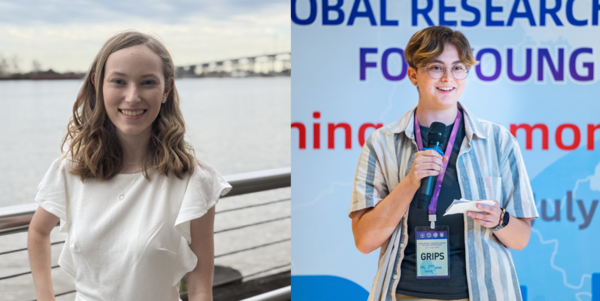
Seminar Speakers: CliMAS Graduate Students Kaylie Bonifer and Sarah Henry
- Sponsor
- Professor Jeff Trapp
- Views
- 16
Kaylie Bonifer:
From Risk to Response: How Emergency Managers Perceive Different Weather Hazards and Use NWS Guidance to Make Decisions
Understanding how emergency managers interpret weather hazards and how National Weather Service (NWS) stakeholders integrate forecast guidance into decision-making is critical to effective hazard response. This work uses two complimentary approaches to identify gaps in communication and risk perception between emergency managers and NWS partners. First, a qualitative investigation examined how stakeholders interpret and communicate weather information related to winter road hazards. Focus groups comprised of 15 participants were interviewed and represented a diverse group of professional backgrounds and experiences, of which included the Department of Transportation, school district representatives, emergency managers, and other stakeholders. We divided focus groups into two parts to explore: (1) the flow of weather information from the NWS to stakeholders and (2) how stakeholders used NWS products and information. Qualitative thematic analysis identified communication gaps between the two groups and proposed ways to address them. We also provide recommendations to better equip stakeholders for future winter weather decision-making. Secondly, because little is known about how emergency managers perceive a range of weather threats, or how these perceptions compare to those of the public, a quantitative nationwide survey of 1,123 emergency managers and 4,968 members of the public assessed risk perceptions across multiple weather hazards to identify areas of alignment and divergence. This analysis provides new insight into how emergency managers and public perspectives intersect, informing strategies to improve communication, decision support, and risk management practices. Preliminary findings suggest that several emergency manager and public risk perceptions are statistically significant and dominant hazards of regions vary geographically.
Sarah Henry:
Anthropogenic Forcing of Historical and Projected Tropical Cyclone Activity
Limited observations have made it challenging to attribute changes in tropical cyclone (TC) activity to anthropogenic influences. Here, we use NeuralGCM, a hybrid machine learning general circulation model to perform ensemble attribution experiments from 2004 to 2023. The factual simulations are prescribed with ERA5 reanalysis sea surface temperature (SST) and sea ice concentration (SIC), while the counterfactual simulations are driven by SST and SIC with the estimated anthropogenic influence removed, representing a climate state (including climate variability) without anthropogenic influences. Compared to the counterfactual experiment, the factual experiment shows a significant decrease in TC frequency and lifetime in the North Atlantic, eastern North Pacific, and western North Pacific basins. To evaluate whether anthropogenic signals in TC activity are detectable in the observational record, the factual simulations are extended back to 1940. TC activity in the historical simulations does not reveal a trend consistent with the changes between the counterfactual and factual experiments. The advantages and limitations of the NeuralGCM are also discussed.
To better understand the effects of anthropogenic forcings on tropical cyclone (TC) activity, we investigate the individual impacts of anthropogenic aerosols (AAER), greenhouse gases (GHG), and biomass burning aerosols (BMB) on TC frequency using CESM2 large ensemble simulations. Changes in TC genesis are estimated using a dynamic genesis potential index (DGPI), which reveals distinct impacts from AAER and GHG. Increasing GHG emissions result in a decrease and southward shift in DGPI over the North Atlantic and the eastern North Pacific since 1940, whereas the time-dependent AAER emissions lead to a decrease and southward shift in DGPI before 1980s and an increase and northward shift thereafter. In addition, BMB emission increases lead to a slight increase in TC frequency in the North Atlantic. Various dynamic and thermodynamic parameters act cooperatively to change TC frequency associated with GHG and AAER over the North Atlantic, while the increase in DGPI associated with BMB is mainly due to the changes in dynamic variables. AAER effects largely dominate DGPI changes in earlier decades, but GHG effects become increasingly dominant in recent decades. Near-future projections, characterized by continued increases in GHG emissions and steady or declined AAER emissions, suggest decreased DGPI over the North Atlantic and eastern North Pacific driven primarily by GHG forcing. A comparison between DGPI and a traditional GPI shows similar increases or decreases in TC genesis potential with quantitative differences. However, comparisons between CESM2, CESM1, and six CMIP6 models show considerable inter-model spread, highlighting model uncertainties and the need for caution when applying and interpreting multi-model ensemble means.