- Sponsor
- IQUIST
- Speaker
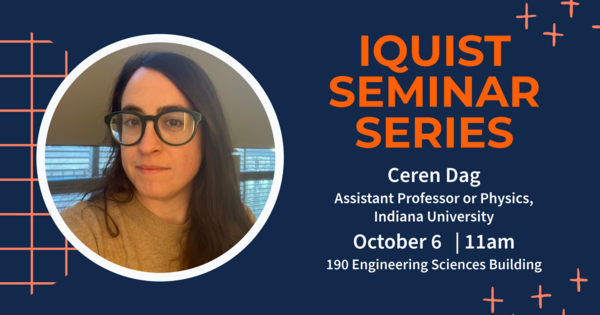
- Ceren Dag
- Contact
- Stephanie Gilmore
- stephg1@illinois.edu
- Phone
- 217-244-9570
- Views
- 58
- Originating Calendar
- IQUIST Seminar Series
"Quantum Hall Ferromagnetism in a Cavity Vacuum"
Abstract: Vacuum field fluctuations have been the focus of much attention recently due to state-of-the-art cavities that can enhance these fluctuations to a degree where electronic properties of 2D quantum materials can be altered. In this talk, I will focus on our recent results [1] where we uncover a continuous phase transition in a quantum Hall ferromagnet (QHF) at unit filling factor driven by vacuum fluctuations of a cavity. Through density matrix renormalization group simulations, analytic spin wave calculations and mean-field theory, we show that for a spatially antisymmetric cavity field, the uniform QHF state is stable only for weak light-matter coupling and gives way to states of inhomogeneous electron density above a critical coupling. These states involve ``flanks'' of uniform QHF fluids, separated by a ``compact core'' of doubly occupied orbitals, which we dub as ``compact-core phases". Remarkably, the photon number is found to probe the order parameter of the transition, providing a possible experimental signature of the electronic transition and the compact-core states. Our study offers a rare example of a phase of electrons stabilized solely by coupling to the enhanced vacuum fluctuations of a cavity mode.
If time permits, I will change gears and explain how vacuum fluctuations can be made chiral, that is time-reversal symmetry breaking, and how we can use chiral cavities to engineer band topology in graphene [2].
[1] arXiv: 2609.14838
[2] Physical Review B 110 (12), L121101 (2024), Nature Communications 16 (1), 5270 (2025).
Bio: Ceren B. Dag earned her PhD in Physics in 2021 at the University of Michigan Ann Arbor. Subsequently, she became an ITAMP (Institute for Theoretical AMO Physics) Fellow at Harvard University. Since 2025, she has been an assistant professor at Indiana University Bloomington. She was named Scialog Fellow by RCSA in Quantum Matter and Information program in 2025-2027. Her work lies at the overlap of condensed matter theory, AMO physics, and quantum information science.