NPRE 596 Graduate Seminar Series - Anurag Mann
- Sponsor
- NPRE 596 Graduate Seminar Series
- Speaker
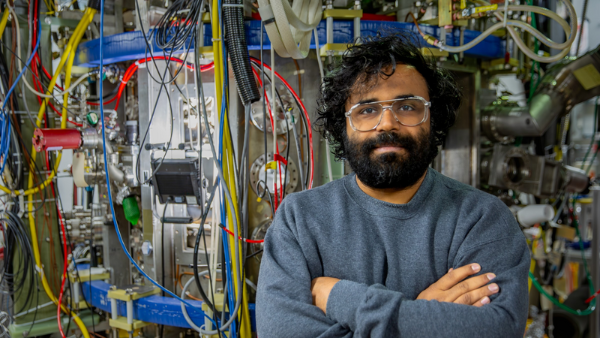
- Anurag Mann, Staff Research Physicist, Princeton Plasma Physics Laboratory
- Cost
- Free and Open to the Public
- nuclear@illinois.edu
- Phone
- 217-333-2295
- Views
- 18
- Originating Calendar
- NPRE seminars
A summary of physics results with low recycling lithium walls in LTX-β and implications for low-recycling operation in future devices
Fusion pilot plant studies identify energy confinement as one of the strongest physics levers on tokamak pilot-plant capital cost [1]. To date, two tokamak devices, NSTX and LTXβ, have reported an improvement of a factor of 2 in confinement over conventional scalings, the largest reported for any device. Both used evaporatively deposited lithium coatings [2, 6]. Lithium chemically retains hydrogenic fuel rather than returning incident ions as cold neutrals. The lower neutral density reduces edge charge-exchange cooling and neutral fueling, raises the edge temperature, weakens temperature gradients, and improves confinement [3, 4, 5, 6]
For well conditioned discharges, ensemble averaged LTX-β discahrges show a recycling coeffecient of 0.5, the lowest recorded value of any device [5]. We will summarize the experimental results from the LTX-β program, including flat electron temperature profiles, lowrecycling scrape-off-layer conditions, and improved confinement that result from clean lithium wall coatings on the plasma facing surfaces of the tokamak. State of the art in lithium evaporator development will also be presented. These newer evaporators developed on LTX-β will soon be fielded on the National Spherical Torus Experiment Upgrade (NSTX-U) and Tokamak Energy run ST40 spherical tokamak. Operational experience from operating the tokamak with lithium walls will be summarized.
The more extreme core electron temperature profile modifications were observed at lower densities in LTX-β. In the extreme cases, the ion and electron collisionality at the last closed flux surface can be an order or two below unity for these discharges. Fluid models of Scrape-Off Layer transport are invalid under these conditions. We will show first results from experimentally constrained 1D-2V full-f gyrokinetic simulations of a field line from the scrape-off layer with lithium boundary conditions. The low-recycling case develops a hotter scrape-off layer, larger electrostatic-potential variation. As ion collisionality falls below unity, mirror-trapped non-Maxwellian ion structure strengthens and normalized particle and energy residence times along the field lines increase compared to fluid approximations. Low recycling discharges with a hot edge must be fueled from the core in order to avoid collapsing the hot edge and corresponding confinement enhancements. Since lithium walls suppress neutral density, such plasmas have fewer fast-ion charge-exchange loss, ionized lithium in the core also can increase beam capture: for 12–20 keV hydrogen, the H0–Li3+ beam capture cross section is approximately 5×10⁻¹⁵ cm2, about an order of magnitude larger than resonant hydrogen charge exchange. Together, these results show how lithium delivery, kinetic exhaust physics, and core fueling form a coupled low-recycling operating scenario.
Acknowledgement: This work is supported by US DOE contract DE-AC02-09CH11466.
[1] M. R. Wade and J. A. Leuer, Fusion Science and Technology 77, 119 (2021). [2] R. Maingi, et al., Physical Review Letters 105, 135004 (2010). [3] R. Majeski, et al., Physical Review Letters 97, 075002 (2006). [4] D. P. Boyle, et al., Physical Review Letters 119, 015001 (2017). [5] A. Maan, et al., Physics of Plasmas 31, 022505 (2024). [6] D. P. Boyle, et al., Nuclear Fusion 63, 056020 (2023).
Bio: Anurag received his doctoral degree from the University of Tennessee, Knoxville in 2020. For now, he is involved in most operational aspects of the Lithium Tokamak Experiment-𝛽 (LTX-𝛽). He also spends some time thinking about lithium operations on the National Spherical Torus Experiment-Upgrade (NSTX-U). He is most interested in the edge physics of a tokamak with lithium walls.