- Sponsor
- The Association for the Advancement of North Caucasus Studies (AANCS)
- Speaker
- Diego Benning Wang
- Registration
- Registration
- Contact
- Mia Alibi
- malibi@illinois.edu
- Views
- 90
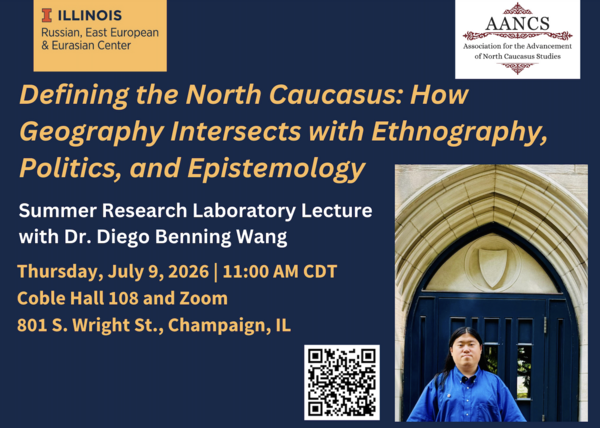
This lecture will examine the historical, geographic, ethno-linguistic, and epistemological challenges involved in defining the North Caucasus as a region. Unlike the South Caucasus, whose conventional geopolitical boundaries rest on three internationally recognized sovereign states, the North Caucasus resists comparable delineation. The lecture will discuss how available administrative, geographic, linguistic, ethnographic, and historical definitions fail to converge. Soviet nationality policy fragmented some communities, agglomerated others, and transformed traditional local identities into durable modern ethno-national categories. Current administrative borders within the Russian Federation produce further mismatches. Physical geography offers no stable solution, as the Greater Caucasus watershed is intersected by river systems, transit routes, political boundaries, and the Black and Caspian Seas. The lecture will also analyze ethno-linguistic continuities across the North and South Caucasus and beyond. With the recent establishment of the Association for the Advancement of North Caucasus Studies (AANCS), scholars of the North Caucasus across North America have come together to build an unprecedented platform for advancing the study of the region and its connections with the South Caucasus, the Black Sea region, and beyond. Part of the scholarly significance of North Caucasus studies as a field of regional studies lies precisely in the non-convergence of topography, ethno-demographics, languages, and territories across various historical periods.
Diego Benning Wang is a historian of the Caucasus, Armenia, Central Asia, and the Russian North in the modern period. He received a Ph.D. in History from Princeton University, an M.A. in Russian Studies from Columbia University, and a B.A. in Russian Studies from New York University. He is currently a visiting scholar at Harvard University, where he is expected to receive an AM in Armenian studies in 2027. He has previously been a visiting scholar at Columbia University and has taught at Princeton University, Kean University, Union County College, and Benjamin Franklin Cummings Institute of Technology. In June 2026, he co-founded the Association for the Advancement of North Caucasus Studies (AANCS), where he currently serves as the vice president.