Maggs Fellow Talk with Dr. Sergey Katsuba: "Institutional Discrimination as an Authoritarian Practice: The Case of Political Homophobia in Russia"
- Sponsor
- REEEC
- Speaker
- Sergey Katsuba
- Registration
- Registration
- Contact
- Mia Alibi
- malibi@illinois.edu
- Views
- 45
- In just over thirty years of modern Russian statehood, LGBTQ rights have undergone a dramatic reversal — from a symbol of legal liberalisation to a platform for authoritarian control. In 1993, same-sex relations were decriminalised. Two decades later, the 2013 “gay propaganda” law introduced sweeping censorship of queer visibility through ambiguous administrative fines. Another ten years on, repression escalated into the realm of criminal law: in 2023, the Supreme Court designated the LGBTQ movement an “extremist” organisation, making any form of affiliation punishable by up to six years in prison. This trajectory reflects how decriminalisation, rather than catalysing greater reform, created a legal void and left space for a state-led project of institutionalised discrimination, which took off when the conditions required.My research traces how this reversal developed into a system of anti-LGBTQ repression as a technique of authoritarian governance in contemporary Russia. At its core is large-scale archival research, including coded database of 233 judicial rulings enforcing anti-LGBTQ censorship laws and a longitudinal dataset of over 1,200 hate crime cases spanning sixteen years (2010–2025), which traces the spikes of everyday violence that coincided with these developments. These materials reveal how repression is performed, enforced, and lived.
Reading the court cases illuminates the Kafkaesque logic of judicial enforcement of anti-LGBTQ legislation: people have been fined, arrested, or deported for wearing rainbow-patterned clothing, for selling queer-themed books, for publishing online comics, for posting dating profiles, for organising film screenings, and running thematic events — all prosecuted under deliberately vague legal provisions. As for the hate crime data, it captures the afterlife of these laws: stories of individuals attacked, humiliated, or killed, and recurring patterns of collective violence legitimised under the shadow of state-endorsed stigma. Together, the datasets expose how law becomes a conduit for social hostility and violence, and how moral panic is translated into both symbolic legalistic repression and material harm.
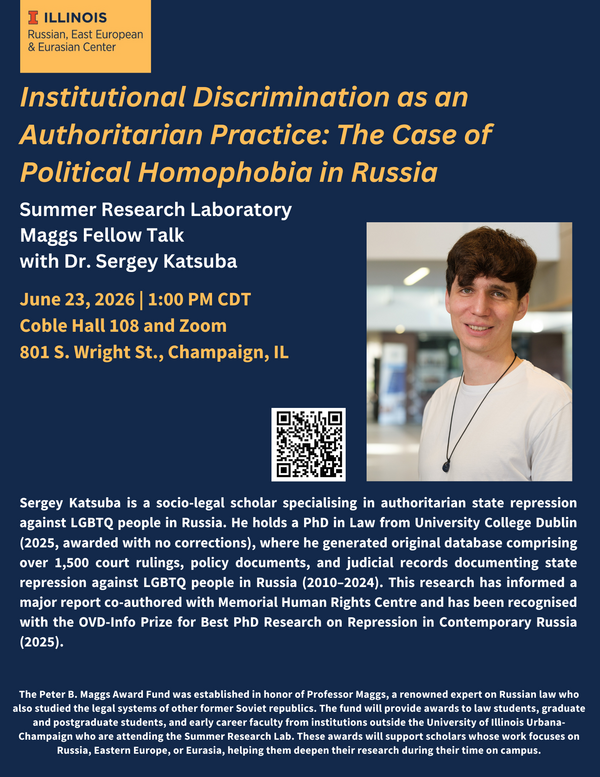
Sergey Katsuba is a socio-legal scholar specialising in authoritarian state repression against LGBTQ people in Russia. He holds a PhD in Law from University College Dublin (2025, awarded with no corrections), where he generated original database comprising over 1,500 court rulings, policy documents, and judicial records documenting state repression against LGBTQ people in Russia (2010–2024). This research has informed a major report co-authored with Memorial Human Rights Centre and has been recognised with the OVD-Info Prize for Best PhD Research on Repression in Contemporary Russia (2025).