Asian/Asian American Faculty & Students: Ink Shower Gallery Tour & Luncheon
Nov 6, 2026 11:00 am - 1:00 pm
Krannert Art Museum
- Sponsor
- Hosted By: Center for East Asian & Pacific Studies and Asian American Cultural Center; Co-Sponsor: Krannert Art Museum
- Registration
- Registration
- Originating Calendar
- CEAPS Events Calendar
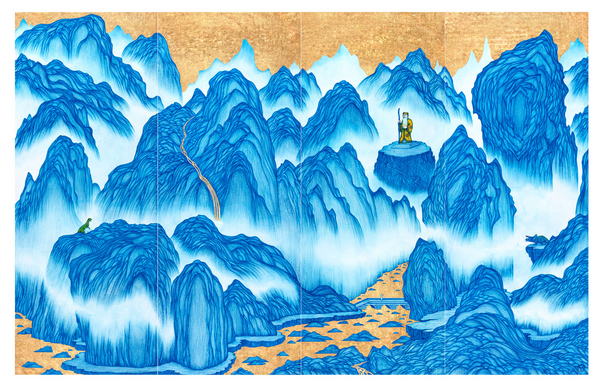
Yao Jui-Chung, Land is Wealth: Money God, 2025. India handmade paper, Pitt artist pen, and gold leaf. 77 × 120 inches (4-panel screen). Courtesy of the artist. © Yao Jui-Chung.We would like to invite any Asian/Asian American Faculty or Students to a private tour of the Ink Shower Art Exhibit, which will be in residency at the Krannert Art Museum. The tour will be led by Ink Shower's visiting curator & artists from Taiwan. Following the tour will be a lunch for all attendees.
🗓️Friday, November 6th⏱️11am - 1pm
📍Krannert Art Museum
Please RSVP as spots are limited due to capacity.Ink Shower is co-curated by Kai-Ching Hsiao, PhD Candidate, Department of Art History and Art Criticism, Tainan National University of the ArtsAbout the Artists:
Agi Chen (陳怡潔) re-encodes popular culture, animation imagery, and digital color through painting, video, and projection mapping, transforming mass visual experience and contemporary perception.Chen Chun-Hao (陳浚豪) recreates classical painting with mosquito nails, thumbtacks, and industrial materials, transforming brushwork, texture strokes, and qi into metallic points and repetitive bodily labor.Cheng Chung-Hsiao (鄭崇孝) uses the Pouty Boy as a pictorial persona, combining cartoon color, humor, and art-historical remixing to bring classical landscape and canonical painting into contemporary contexts.Chien Yu-Jen (簡佑任) reconstructs landscape screens with cement, sand, minerals, ink, and found objects, drawing on mountaineering experience and material experimentation to consider nature and modernization.Hua Chien-Chiang (華建強) combines nihonga, ink, and acrylic with vivid color, imagined imagery, and decorative composition, creating landscapes between tradition, comic sensibility, and contemporary fable.Lee An-Cheng (李安成) uses ink washes, brushy textures, and weighty blacks and whites to form psychic landscapes between figuration and abstraction, transforming land, perception, and inner spirit into a solitary ink language.Lee Ming-Tse (李明則) works with comic-like lines, folk imagery, martial arts memories, and vernacular narratives to create a pictorial world shaped by literati taste, local color, and fantastical storytelling.Lin Chun-Pin (林俊彬) uses Gundam model parts as sculptural material, turning pop-cultural commodities into three-dimensional landscapes and assembled terrains that reflect on readymades, reproduction, and artistic value.Lin Chun-Ting (林俊廷) explores new media, interactive video, and sound installation, combining technology, humanistic thought, and classical imagery to turn images into dynamic spaces of perception.Wu Chi-Tsung (吳季璁) works across photography, video, installation, and painting, often using light, time, and everyday materials to reconstruct landscape texture strokes through poetic media experiments.Wu Tsan-Cheng (吳燦政) centers his practice on field recordings, environmental soundscapes, and online mapping, using sound as a medium for sensing land, cities, and changes in time.Yao Jui-Chung (姚瑞中) works across photography, painting, installation, performance, and publishing, often using humor, appropriation, and critique to address history, ruins, power, and the imagination of landscape.