Characterizing Tidal Disruption Events and AGN Variability
- Sponsor
- Department of Astronomy
- Speaker
- Dr. Samaresh Mondal
- Contact
- Daniel Franco
- danielf9@illinois.edu
- Phone
- 217-300-6769
- Originating Calendar
- Astronomy Colloquium Speaker Calendar
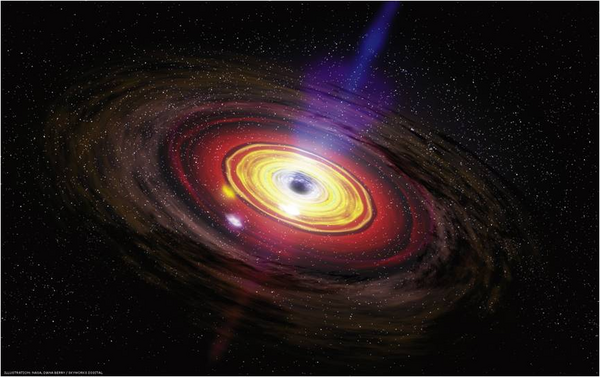
Recent advances in wide-field time-domain surveys have led to the discovery of an increasing number of tidal disruption events (TDEs). TDEs are critical astronomical events that provide a way to explore multiple astrophysical avenues, such as (1) probing the demographics of supermassive black holes at the lower mass end, (2) the onset of jet launching, (3) accretion physics at high Eddington rates, and (4) corona formation. However, the X-ray flaring activity from active galactic nuclei (AGNs) may mimic the expected emission from TDEs. In this talk, I will discuss the various methods that can be used to separate TDEs from flaring AGNs, utilizing both variability in X-ray light curves and spectroscopic information. For the identification of X-ray-detected AGNs and TDEs, we cross-matched publicly available Swift-XRT and XMM-Newton point source catalogs with the Million Quasars Catalog and optically selected TDEs. The maximum variability comparison indicates AGN flares have a similar order of variation as TDEs on a time scale of less than 20 days. However, when looking at a longer time scale, the large-scale variation expected from TDEs becomes less frequent in AGNs. Furthermore, we find that during the flaring activity, AGN spectra tend to become softer with similar hardness ratio values as TDEs, indicating that separating TDEs from soft AGN flares can be extremely difficult. The softening of AGN spectra during the flares is driven by the emergence of a blackbody-like component likely associated with soft X-ray excess, as well as continuum emission becoming steeper due to an increase in accretion rate. At the end, I will discuss the properties of hard X-ray emission in TDEs.