PhD Defense | Suspended Sediment Dynamics in an Intensively Managed Agricultural Landscape
- Sponsor
- Department of Geography and Geographic Information Science
- Speaker
- Chelsy Salas, Geography PhD candidate
- Cost
- This dissertation defense is free and open to the public.
- Contact
- Geography & GIS
- geography@illinois.edu
- Views
- 37
- Originating Calendar
- Geography & Geographic Information Science
Suspended Sediment Dynamics in an Intensively Managed Agricultural Landscape: Floodplain-Channel Connectivity, Seasonality, and Event-based Variability
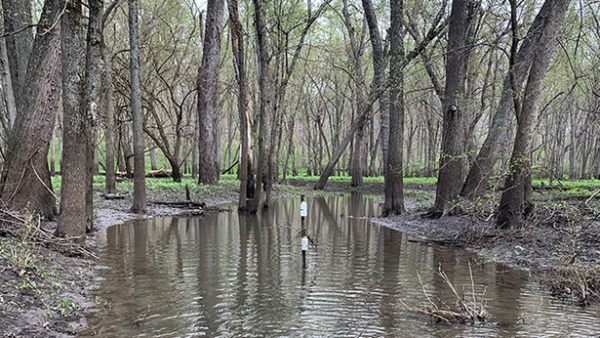
The suspended-sediment dynamics of river systems reflect complex interactions among watershed- and reach-scale hydrology and geomorphology. In intensively managed agricultural landscapes, these dynamics are complicated by extensive landscape modifications that alter pathways of water and sediment transport. Additional complexity arises from spatial and temporal variation in floodplain inundation, flow patterns, and river-floodplain connectivity, all of which influence floodplain suspended-sediment dynamics.
This study examines the suspended-sediment dynamics of the Upper Sangamon River of Illinois at watershed and reach scales. The objectives are to:
(1) quantify spatial and temporal variations in floodplain suspended-sediment dynamics during overbank flood events, (2) examine sediment-discharge relationships in the river across event, seasonal, and annual timescales, and
(3) investigate spatial and temporal variations in modelled floodplain flow patterns and relate these patterns to field-based measurements of suspended sediment.Results show that floodplain SSCs are consistently lower than SSCs in the main river channel yet vary spatially according to geomorphic setting and river-floodplain connectivity. Secondary channels function as preferential pathways for the delivery of water and sediment to the floodplain and exhibit greater SSCs, flow velocities, and deposition than adjacent floodplain surfaces.
At the watershed scale, runoff events are characterized by first-flush sediment responses followed by sediment dilution near peak discharge, resulting in weak and, in some cases, negative SSC-discharge relationships. Hydraulic modeling further demonstrates that floodplain flow patterns vary systematically with stage and discharge, reflecting changes in connectivity between the main channel and floodplain.
Collectively, the results advance understanding of suspended sediment dynamics in lowland river systems by quantifying variability in sediment transport across multiple spatial and temporal scales and by linking observed sediment patterns to channel-floodplain connectivity and floodplain flow dynamics.