- Sponsor
- IMMERSE Center for Immersive Computing
- Speaker
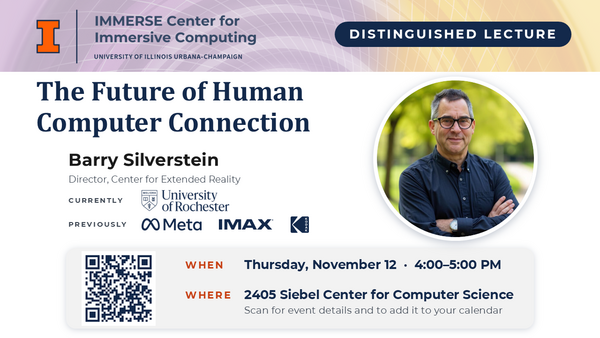
- Barry Silverstein
- Contact
- James Planey
- planey@illinois.edu
- Views
- 254
- Originating Calendar
- IMMERSE Seminar Series
This event is hybrid, in person at 2405 Siebel Center for Computer Science and on Zoom: https://go.illinois.edu/immerseseminarsilverstein
Abstract:
As artificial intelligence grows more capable, a familiar anxiety resurfaces: will humans become unnecessary? This talk argues for a different answer — one in which the goal is not to compete with AI but to build the interfaces through which humans and AI collaborate at their mutual best.
Within the decade, digital overlays driven by contextual AI and delivered through AR will begin reshaping how we perceive and navigate the world — enhancing surgical precision, transforming how students learn, and redefining what it means to interact with a computer. The question is not whether this transition will happen, but who will design it and toward what ends.
The University of Rochester's Center for Extended Reality (CXR) brings together faculty across engineering, medicine, neuroscience, education, and the humanities to pursue that design challenge as a shared mission. This talk presents CXR's transdisciplinary framework — spanning hardware innovation in optics and display, human-computer interface research, applied clinical development, and ethical governance.
Speaker Bio:
Barry Silverstein joined the University of Rochester in 2026 as Director of the Center for Extended Reality, and faculty of the Institute of Optics following eight years as Senior Director and CTO of Optics and Display at Meta's Reality Labs. There he led development of advanced visual imaging systems, including uLED, LCoS, and laser scanning engines, novel lightweight materials, and waveguides using volume holography and surface relief gratings.
Drawing on additional experience at IMAX and Kodak, Silverstein brings deep expertise in optical systems, laser projection, sensing, and imaging across research, development, and commercialization. He is a 2024 Academy of Motion Picture Arts and Sciences Scientific and Engineering Award winner for his contributions to the IMAX Prismless Laser Projector, and holds 100 awarded US patents.
Refreshments will be provided.