ISGS Seminar | Nuclear Energy and Waste Management: Geology Matters!
- Sponsor
- Illinois State Geological Survey
- Speaker
- Professor William Roy
- Views
- 23
Prof. William Roy is in the Department of Nuclear, Plasma, and Radiological Engineering at the University of Illinois. He holds B.S. and M.A. degrees in Geology, and a Ph.D. in Soil Physical Chemistry. He is a Commissioner for the Central Midwest Low-Level Radioactive Waste Compact. He is a Lecturer for the European Commission. Prof. Roy is the author of the textbook Radioactive Waste Management in the 21st Century, which was published by World Scientific Publishing. He is also a former Geochemist at the Illinois State Geological Survey.
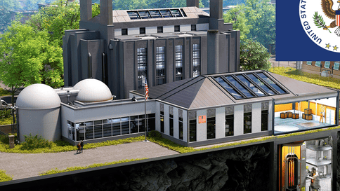
This seminar will explore the connections between the various applications of geology that support nuclear energy and the safe management of radioactive wastes. Local and international examples are provided to make those connections. The Grainer College of Engineering via the Illinois Microreactor Demonstration Project has submitted a Construction Permit Application to the Nuclear Regulatory Commission in partnership with NANO Nuclear Energy to construct a KRONOS Microreactor on campus. As part of that application, a detailed site assessment was conducted which included information about the geology and hydrogeology of the site was required. In place of the more familiar containment dome on the surface, the Microreactor will be underground. There are examples of underground reactors such as Reactor 1 and the Ågesta Nuclear Plant both in Sweden, the Chooz A Nuclear Plant in France, and the Lucens Reactor in Switzerland. It is the international consensus of nations using nuclear energy that subsurface burial of nuclear wastes is the safest option for isolating wastes from the biosphere. Subsurface burial is used for Low-Level Radioactive Wastes, Intermediate-Level Wastes, Transuranic Wastes, and Spent Nuclear Fuel. A geological repository is a subsurface excavation into natural geological materials for the long-term containment of long-lived radionuclides. In many countries, a Geological Research Laboratory is established to collect information about the subsurface geology prior to building a repository for spent nuclear fuel. Examples include China and Sweden. The U.S. has a geological repository called the Waste Isolation Pilot Plant in New Mexico. The Department of Energy has initiated a program to establish a surface facility for the interim storage of spent nuclear fuel. Low-Level Radioactive Wastes are disposed by shallow-land disposal. Examples include the proposed Martinsville Facility in Illinois, and the Texas Compact Disposal Facility. In conclusion, geology has a vital role in supporting nuclear energy and radioactive waste management. This connection needs to be emphasized to the general public, and to all levels of government.
To attend online, contact info@isgs.illinois.edu for a Teams link.