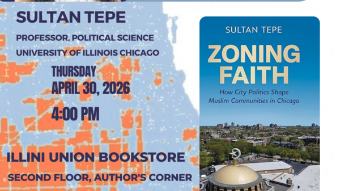
Book Talk: Zoning Faith: How City Politics Shape Muslim Communities in Chicago, Sultan Tepe
- Sponsor
- Center for South Asian and Middle Eastern Studies
- Views
- 98
- Originating Calendar
- Middle East Events
An intriguing look at how the city's built environment influences the shape of Muslim communities in Chicago
Zoning Faith offers a rare in-depth look at three distinct Muslim communities in Chicago, one Shia Muslim, one Sunni, and one Black Muslim community. The volume explores how these communities navigate their social and political environments, and how their experiences in urban settings help to explain the emergence of new Islamic organizations, practices, and theologies in America.
Zoning Faith provides the first comprehensive spatial examination of Muslims' experiences in global cities. Although cities play a crucial role in the enactment of faith, they are often treated as places Muslims happen to live, or as places that are transformed as many Muslims come to inhabit them. Little attention has been paid to the ways in which cities may transform faith groups in meaningful ways, from zoning regulations and debates about where a mosque can be situated to how a building’s structure can influence prayer and communal life. This book pays careful attention to the intersections of urban space and religion, approaching “built spaces” as profoundly political and particularly illuminating of the experiences of minority faiths.
Drawing on a multi-year and multi-site ethnography, the volume provides a previously unobtainable, in-depth look at how Muslim communities in Chicago defy the expectations of conventional places of worship. Crossing the boundaries of urban studies, theological studies, architecture, and public policy, Zoning Faith offers new insights into how Islam is vernacularized and grounded in the US in many different ways.