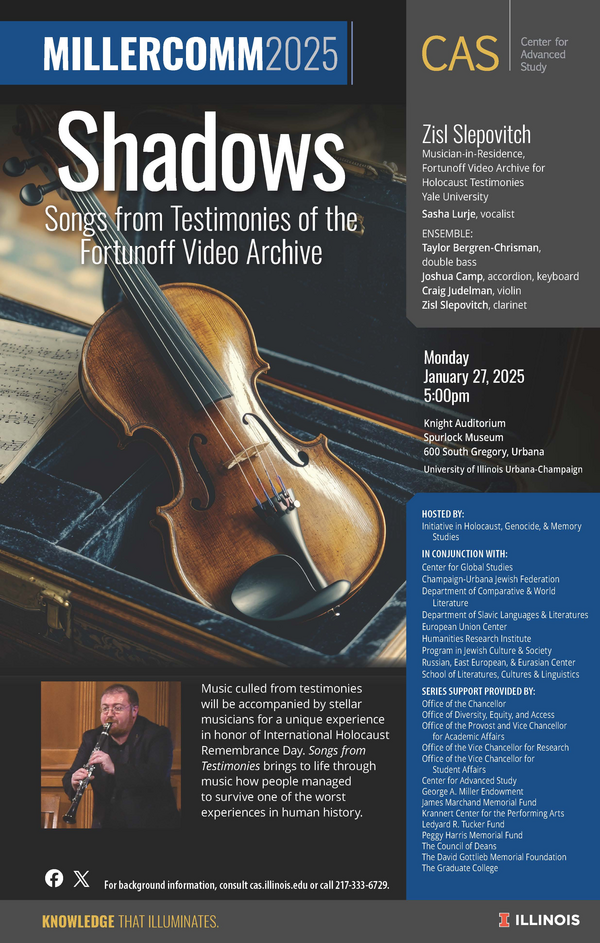
Shadows: Songs from Testimonies of the Fortunoff Video Archive
- Sponsor
- Initiative in Holocaust, Genocide, & Memory Studies, Center for Global Studies, Champaign-Urbana Jewish Federation, Department of Comparative & World Literature, Department of Slavic Languages & Literatures, European Union Center, Humanities Research Institute, Program in Jewish Culture & Society, Russian, East European, & Eurasian Center, School of Literatures, Cultures & Linguistics
- Speaker
- Zisl Slepovitch (Musician-in-Residence, Fortunoff Video Archive for Holocaust Testimonies, Yale University)
- Cost
- Free and open to the public.
- Contact
- Brett Ashley Kaplan
- bakaplan@illinois.edu
- Views
- 136
- Originating Calendar
- Russian, E. European & Eurasian Center: Co-sponsored Events
Zisl Slepovitch's Ensemble and Sasha Lurje present a selection of songs discovered, curated, transcribed, and arranged by Dr. D. Zisl Slepovitch, Musician-in-Residence at Fortunoff Video Archive for Holocaust Testimonies at Yale University, a unique collection of 4400 interviews conducted mainly in the 1980’s–90's. The songs in the program provide a series of insights into the Holocaust survivors’ experiences both during World War II and in the pre-war time as they were growing up. The widely diverse compositions form a timeline that helps recreate a multidimensional image of people’s lives and the multiple identities they carried — as Jews by faith and roots, and as European citizens — Poles, Germans, Russians– by culture. These identities were shaped during the vibrant and dynamic interwar period, which is represented by several songs. The core of the program, however, conveys the ways people managed to survive during the Holocaust, not in the least thanks to the support they gained through the songs they wrote and sang in the ghettos and concentration camps all across Central and Eastern Europe. The songs in many languages are arranged and interwoven with the matching instrumental pieces performed by a 4-piece instrumental ensemble.
Hosted by: Initiative in Holocaust, Genocide, & Memory Studies
In conjunction with: Center for Global Studies, Department of Comparative & World Literature, Department of Slavic Languages & Literatures, Humanities Research Institute, Program in Jewish Culture & Society, Russian, East European, & Eurasian Center, School of Literatures, Cultures & LinguisticsSasha Lurje, vocalist
Ensemble:
Taylor Bergren-Chrisman, double bass
Joshua Camp, accordion, keyboard
Craig Judelman, violin
Zisl Slepovitch, clarinet