As the home to the area and global studies centers and thematic programs at the University of Illinois Urbana-Champaign, the Illinois Global Institute is dedicated to fostering an environment where international perspectives are integral to teaching and research.

Center for African Studies * Center for East Asian and Pacific Studies * Center for Global Studies * Center for Latin American and Caribbean Studies * Center for South Asian and Middle Eastern Studies * Center for the Study of Global Gender Equity * European Union Center * LAS Global Studies * Lemann Center for Brazilian Studies * Russian, East European, and Eurasian CenterThe Program in Arms Control and Domestic and International Security


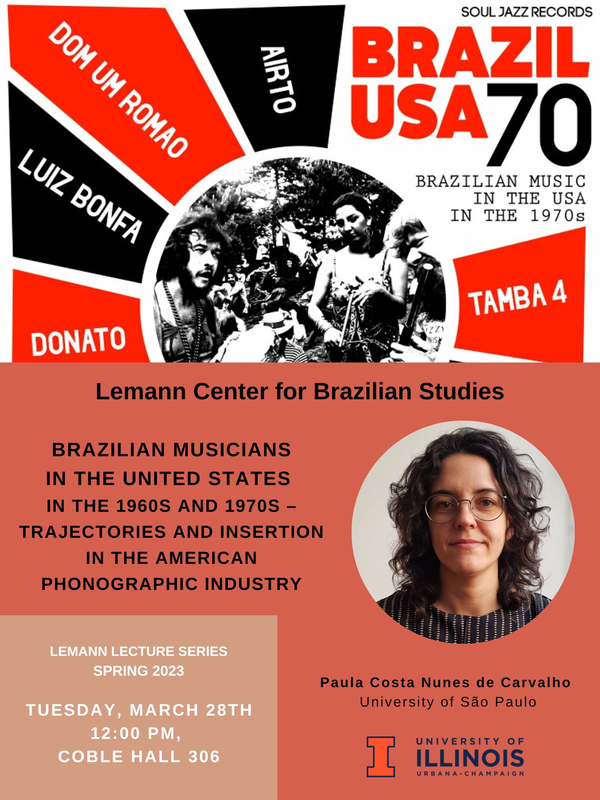
Lemann Lecture Series - Paula Costa Nunes de Carvalho, Brazilian musicians in the United States in the 1960s and 1970s – trajectories and insertion in the American phonographic industry
Mar 28, 2023   12:00 - 1:30 pm  
Coble Hall 306
Tuesday, March 28th 12:00 PM - 1:30 PM Coble Hall, Room 306 (801 S. Wright St.)  Paula Costa Nunes de Carvalho  University of São Paulo     	 Brazilian musicians in the United States in the 1960s and 1970s – trajectories and insertion in the American phonographic industry    	  The idea of this talk is to share some findings about an ongoing study concerning the transits of musicians between Brazil and the United States in the 1960s and the 1970s. Going beyond the "Bossa nova in the Carnegie Hall" concert, I explore some trajectories of musicians like Tom Jobim, Eumir Deodato, Sergio Mendes and Moacir Santos. How did these musicians insert themselves in a professional music circuit much more developed than in Brazil? The bossa nova internationalization began, among other things, because of the contact between American and Brazilian musicians following Charlie Byrd and Paul Winter's USIA and DoS-Sponsored tours to Latin America. Following that and the Carnegie Hall concert in 1962, partially supported by the Brazilian government, several Brazilian musicians came to the US independently, trying to take a new step into their careers. Some of them managed to record albums here, others became studio musicians, and a few worked in some other music-related professions, like playing in restaurants or teaching classes. We will look at their insertion in the American music scene through a morphology, emphasizing their will to "play the game" – and not to be "sold out", as part of the more consolidated musical historiography claims.     	 	    Paula Carvalho is a doctoral student in Sociology at the University of São Paulo (USP) and a researcher in the Sociology of Culture Center at the same institution. Her main research topics are popular music; cultural industry and racial relations. She's currently in a 6-month period at the University of Illinois as a Visiting Scholar, advised by Professor Marc Hertzman and supported by CAPES - PrInt and the Brazilian Initiation Scholarship Award, from the Brazilian Studies Association (BRASA).
Sponsor
The Lemann Center for Brazilian Studies
Speaker
Paula Costa Nunes de Carvalho
Contact
Lemann Center
E-Mail
lemann@illinois.edu
Views
53
Originating Calendar
Lemann Center Events

The idea of this talk is to share some findings about an ongoing study concerning the transits of musicians between Brazil and the United States in the 1960s and the 1970s. Going beyond the "Bossa nova in the Carnegie Hall" concert, I explore some trajectories of musicians like Tom Jobim, Eumir Deodato, Sergio Mendes and Moacir Santos. How did these musicians insert themselves in a professional music circuit much more developed than in Brazil? The bossa nova internationalization began, among other things, because of the contact between American and Brazilian musicians following Charlie Byrd and Paul Winter's USIA and DoS-Sponsored tours to Latin America. Following that and the Carnegie Hall concert in 1962, partially supported by the Brazilian government, several Brazilian musicians came to the US independently, trying to take a new step into their careers. Some of them managed to record albums here, others became studio musicians, and a few worked in some other music-related professions, like playing in restaurants or teaching classes. We will look at their insertion in the American music scene through a morphology, emphasizing their will to "play the game" – and not to be "sold out", as part of the more consolidated musical historiography claims.

Paula Carvalho is a doctoral student in Sociology at the University of São Paulo (USP) and a researcher in the Sociology of Culture Center at the same institution. Her main research topics are popular music; cultural industry and racial relations. She's currently in a 6-month period at the University of Illinois as a Visiting Scholar, advised by Professor Marc Hertzman and supported by CAPES - PrInt and the Brazilian Initiation Scholarship Award, from the Brazilian Studies Association (BRASA). 


link for robots only