Nils Ringe (University of Wisconsin-Madison) , "The Language(s) of Politics: Multilingual Policy-Making in the European Union"
- Sponsor
- European Union Center. Co-sponsored by the Center of Global Studies.
- Speaker
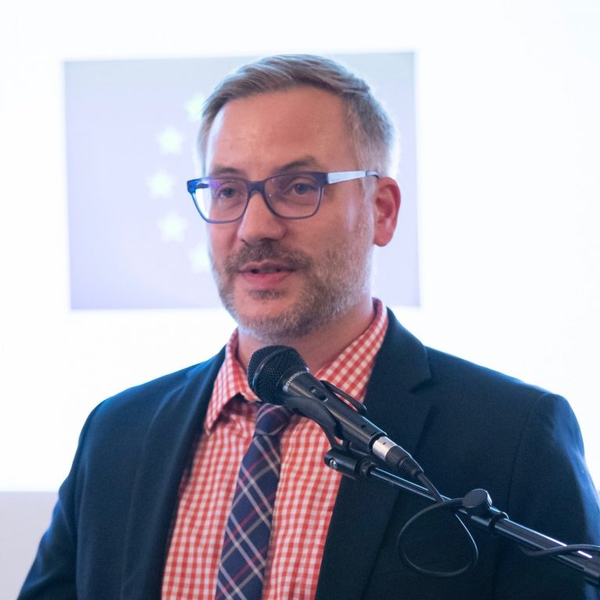
- Nils Ringe
- Views
- 71
- Originating Calendar
- Center for Global Studies: Cosponsored Events
Join Nils Ringe on Friday, November 11th at 12pm at 404 David Kinley Hall for his lecture, "The Language(s) of Politics: Multilingual Policy-Making in the European Union."
Multilingualism is a feature in political contexts around the world, including multilingual states and international organizations. Increasingly, consequential political decisions are negotiated between politicians who do not share a common native language. “The Language(s) of Politics” uses the case of the European Union to investigate how politicians’ reliance on shared foreign languages and translation services affects politics and policy-making. It not only shows that multilingualism is an inherent and consequential feature of EU politics, but also that it depoliticizes policy-making by reducing its political nature and potential for conflict. That is because both foreign language use and reliance on translation result in communication that is simple, utilitarian, neutralized, and involves commonly shared phrases and expressions, which masks the national and political backgrounds, preferences, and priorities of EU actors. Policy-makers also tend to disregard politically charged language because it might not reflect what a speaker meant to say, and they are constrained in their ability to use vague or ambiguous language to gloss over disagreements by the need for consistency across languages. Multilingualism thus affects the EU’s political culture, by shaping perceptions of political differences, polarization of opinion, intensity of debate, and the resonance of arguments and evidence.