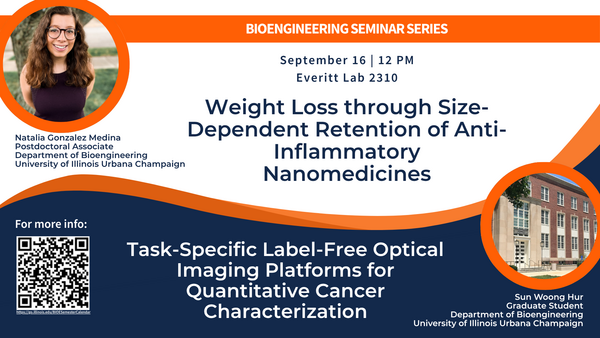
BIOE Seminar Series: Postdoctoral Associate Natalia Gonzalez Medina & Graduate Student Sun Woong Hur
- Sponsor
- Department of Bioengineering
- Originating Calendar
- Bioengineering calendar
Weight Loss through Size-Dependent Retention of Anti-Inflammatory Nanomedicines
By Natalia Gonzalez Medina, Department of Bioengineering, Faculty Advisor, Andrew Smith
Abstract: Obesity is associated with high-mortality conditions, including cardiovascular diseases and type two diabetes. The causal link between obesity and these comorbidities appears to be chronic inflammation mediated by macrophages within adipose tissue. In this talk, I describe dextran nanocarriers designed to deliver an anti-inflammatory drug directly to adipose tissue macrophages. The nanocarriers reduced body weight and body fat in a size-dependent manner and appeared to elicit local changes to promote tissue browning. Unlike current pharmacotherapies, body composition changes were unassociated with food intake. This platform provides a modulator of adipose tissue in obesity without the malnutrition observed with current pharmacotherapies.
Biography: Dr. Natalia Gonzalez Medina is a Postdoctoral Associate working in therapeutics under the mentorship of Dr. Andrew Smith at Illinois. Her research utilizes nanomaterials to target macrophages in disease states like obesity and cancer. She also researches the role macrophages play in adipose tissue microenvironments. Natalia received her PhD in Bioengineering at Illinois where she was a recipient of the National Science Foundation Graduate Research Fellowship in 2018. Before Illinois, she received a BS in Nanoscience from Virginia Tech.
Task-Specific Label-Free Optical Imaging Platforms for Quantitative Cancer Characterization
By Sun Woong Hur, Department of Bioengineering, Faculty Advisor, Rohit Bhargava
Abstract: My research presents task-specific, label-free optical imaging platforms for quantitative cancer characterization across three- scales. First, a spatiotemporal feature-map model utilizing single-shot quantitative phase imaging (QPI) is developed to predict cellular states and media conditions for optimizing 3D tumor cultures. Second, high-throughput 3D full-field optical coherence tomography (FF-OCT) and computational reconstruction methods are introduced to analyze the structural features and nuclear distribution of cancer spheroids. Finally, multimodal back-oblique illumination-based QPI with spontaneous Raman spectroscopy is developed to extract morphological, and chemical signatures from turbid tissue. Together, these platforms advance label-free cancer diagnostics and biological evaluation.