Smart Connected Highway Grade Crossings for Enhanced Safety and Mobility
- Sponsor
- RailTEC at Illinois
- Speaker
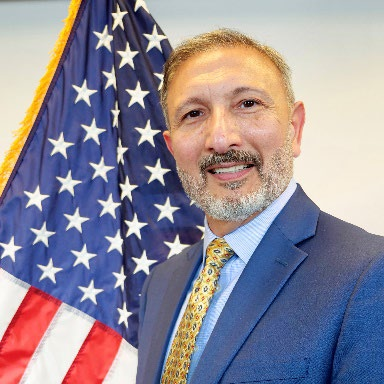
- Sam Alibrahim - Federal Railroad Administration (FRA)
- Registration
- Registration
- Contact
- Krissie Durso
- hayseminar@illinois.edu
- Phone
- 217-300-1340
- Originating Calendar
- William W. Hay Railroad Engineering Seminar
Abstract:
Highway-rail grade crossings across the United States continue to pose significant safety and mobility challenges for communities and transportation networks. Recent data from the Federal Railroad Administration (FRA) blocked crossing portal highlights the widespread nature of the problem, with over 22,000 blocked crossing reports received in less than a year, affecting more than 5,500 crossings nationwide. The frequency and duration of blocked crossings have been exacerbated by increasing train and vehicle traffic, as well as longer trains, leading to heightened risks for motorists, emergency responders, and pedestrians. Traditional solutions such as grade separation, temporal scheduling, and track realignment remain costly, disruptive, or difficult to implement, underscoring the urgent need for innovative approaches to improve safety and mobility at these critical intersections. To address these urgent issues, two complementary research projects will be discussed, one was recently completed and the other one currently underway.
The first project evaluates the use of Cellular Vehicle-to-Everything (C-V2X) communications to deliver real-time predicted train arrival and departure information at both active and passive grade crossings, providing Signal Phase and Timing (SPaT) data to connected vehicles via a cloud-based, roadside, and vehicle subsystem architecture. This systematic approach enables performance assessment and operational testing where no integrated solution currently exists.
The second project pilots a cloud-hosted prediction service that leverages operational railroad movement and location data to forecast crossing encumbrances for Emergency Communications Centers and first responders. Building on prior FRA research, this initiative transitions from controlled facility tests to real-world back-office data, collaborating with Class I railroads to quantify prediction accuracy, latency, false alerts, and impacts on responder delay, with a commercialization path for industry adoption.
Together, these efforts represent a significant step toward innovative, scalable solutions for improving safety and mobility at highway-rail grade crossings.
Bio
Mr. Sam Alibrahim is the Division Chief for Train Control and Communication Research at the Federal Railroad Administration (FRA) Office of Research, Development, and Innovation. With over 30 years of experience in rail transportation across industry and government, Mr. Alibrahim specializes in research, development, design, test, and deployment of advanced signaling and train control systems for freight and passenger railroads in the U.S. and internationally. He holds master’s degrees in Electrical Engineering, Computer Science, and Business Administration from the University of Louisville and is a licensed Professional Engineer in several U.S. states.